The Phelps "Videotape" (2026): Rehearsing the Race, Including the Parts That Go Wrong
Bob Bowman had him play a mental tape of the race before bed. The famous payoff came in Beijing 2008, and the version you have heard is exaggerated.
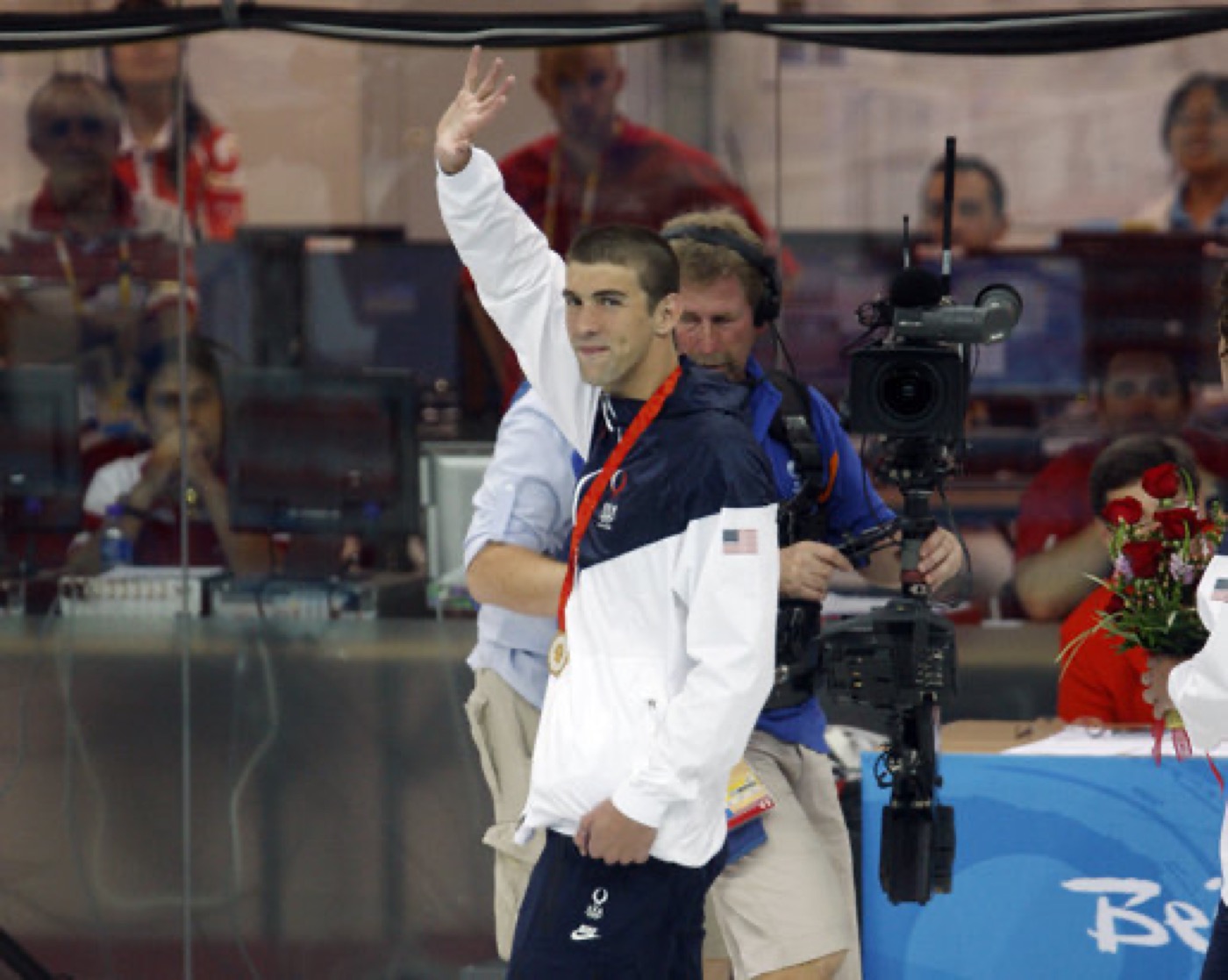
Michael Phelps won the 200-meter butterfly final in Beijing on August 13, 2008, in 1:52.03. It was a world record, and it was his fourth gold of those Games. Laszlo Cseh finished second, 0.67 seconds back.
His goggles filled with water while he swam it.
That race is the most-repeated story in sports psychology, and it is usually told wrong. The habit behind it, though, is real, well documented, and unusually easy to copy: every night before he went to sleep, Phelps ran the race in his head. Not just the good version. The version where things break.
What the goggles story actually was
Start with the correction, because the retellings collapse two different events into one.
You will read that Phelps swam 175 of the 200 meters blind. That is the leak, not the blindness. CBS's own account says the goggles filled with water virtually from the start, so a number close to the whole race is a fair description of how long they were leaking. It is not how long he could not see.
Here is his own number, asked directly about the goggles by Anderson Cooper on CBS's 60 Minutes, posted to CBSNews.com on November 25, 2008 (the broadcast aired that Sunday, November 23): "They started filling up more and more and more. And about 75 meters left in the race, I could see nothing." He went on: "I couldn't see the black line. I couldn't see the T. I couldn't see anything. I was purely going by stroke count." He also explained why he could not simply fix it: "I couldn't take my goggles off because they were underneath two swim caps."
So: they leaked from the start, and his own number for seeing nothing is the final 75 meters. A whole race with water coming in, the last quarter of it navigating by counting. That is remarkable enough without the two facts being welded into one.
One more piece of honesty from the same interview, which nobody repeats. Phelps did not think it was a good swim. Of the eight Beijing golds he said: "There were two races I didn't hit. The 100 and 200 fly. Those are the only two where I didn't hit my actual goal time of what I wanted." The most famous mental-toughness story in swimming is a race its swimmer filed under disappointing.
The habit, precisely
- Run the race in your head before sleep, and again on waking. The nightly mental replay is the core of it, a full run-through of the swim, in order, from the blocks to the wall.
- Rehearse the disaster version too, by name. Not vague trouble. Specific failures: the suit tearing, the goggles going. Phelps has described visualizing the perfect race and also the worst one, so that whatever showed up on the day had already been seen.
- Have a fallback that does not need the thing that broke. His was stroke count. He knew how many strokes a length took, which gave him a way to find the wall that did not depend on seeing it.
- Bowman trained the failure in the real pool, not only in Phelps's head. Bowman writes in his book The Golden Rules (2016) that he builds discomfort into training on purpose: "Three or four times a week, I will put my swimmers in a situation at practice where they are uncomfortable, and I expect them to rise to the occasion, or fall and have to deal with the consequences." Note where that comes from: the book, not the 60 Minutes interview, where this line does not appear. We could not open the book ourselves, so treat it as reported, not verified. The often-told story that he once stepped on Phelps's goggles at a meet belongs to the same approach.
A note on the word "videotape." You will see it everywhere, usually as a Bowman instruction to "watch the videotape" before bed. We could not trace that phrasing to Bowman's own quoted words in anything we were able to read. It appears to reach the internet largely through Charles Duhigg's book The Power of Habit, a journalist's rendering, not a transcript. We are marking the phrase reported, not verified. The underlying habit is separately supported by Phelps's and Bowman's own on-record descriptions; the catchy name for it is not.
What the science says
Mental practice helps, and the effect is small. The largest recent synthesis, Toth and colleagues in Psychology of Sport and Exercise (2020), pooled 37 studies published between 1995 and 2018 and found mental practice had a small but significant positive effect on performance, r = 0.131, and it survived their publication-bias checks. That is a real effect. It is also modest, and mental practice came out weaker than actually doing the thing.
Rehearsing the PROCESS beats picturing the win. This is the finding that matters most, and it is the opposite of what "visualize success" advice tells you. Pham and Taylor (Personality and Social Psychology Bulletin, 1999) assigned 101 undergraduates in a 2x2 between-participants design to spend 5 minutes a day for 5 to 7 days before a midterm mentally simulating either the process of studying, the outcome of a good grade, both, or neither. Students who simulated the process studied about 3 hours more than those who did not, a robust effect, F(1,91) = 7.29, p < .008, and the gap between the hours they planned and the hours they actually put in shrank sharply.
Be careful with that study's headline, though. The exam-score difference: process simulators scoring about 3.5 percentage points higher : was only marginally significant, p < .09, which is not the same as established. What you can lean on is the behavior: process rehearsal got people to do the work. The grade effect is suggestive. Anyone citing it as proof that visualization raises test scores has skipped the p-value.
Nobody has shown any of this wins Olympic finals. The imagery literature is mostly small studies, often on lab or student tasks, with short follow-ups. There is no trial demonstrating that nightly race rehearsal produces gold medals, and there could not easily be one. What the evidence supports is narrower and still useful: rehearsing the steps of a task tends to raise the chance you carry them out.
Why rehearsing the failure is the smart part
Picturing success mostly feels good. Picturing the specific thing going wrong forces a decision, in advance, while you are calm, and a decision made calmly is available to you later, when you are not.
That is the whole mechanism in the Beijing race. Phelps did not win because he had pictured a gold medal. He won because when he lost his vision he already had a second navigation system and no reason to panic about switching to it. He had run that scenario. The response was pre-loaded.
Pham and Taylor point the same way in their own limitations section: the benefit of process simulation appears to run through better planning and lower anxiety, not through the pleasant feeling of imagining the goal. They explicitly flagged rehearsing obstacles as a promising direction for future work.
To be honest about the rest of it: Phelps had a wingspan, a physiology, a coach and a support system almost nobody has. Mental rehearsal is one input among many, and it happens to be the cheapest one to copy. Thousands of swimmers ran the same nightly tape and never made a final.
How to run it yourself, starting tonight
- Pick tomorrow's one hard thing. The presentation, the difficult conversation, the workout, the exam. One, not a list.
- Rehearse it for 5 minutes, in bed, in order. Five minutes is the dose from the Pham and Taylor protocol. Go start to finish: what you do first, then next, then next. Steps, not the applause at the end.
- Then spend 60 seconds on the disaster version. Name one specific failure, the laptop dies, they ask the question you cannot answer, your legs go at mile three. One concrete failure, not general dread.
- Write your stroke count: one fallback sentence. "If the slides die, I talk through the three numbers." "If they ask about cost, I say I will follow up by Friday." That sentence is what stroke count was for Phelps, a plan that does not need the broken thing.
- Keep the rehearsal before sleep, and keep the sleep. Five minutes of mental run-through, then at least 7 hours in bed (Watson et al. 2015, the AASM and Sleep Research Society consensus). If rehearsing pushes your bedtime later, move it earlier in the evening instead. No amount of mental practice buys back a short night.
The mistakes that kill this habit
Only visualizing the win. This is the default version of the advice and the weakest one. In Pham and Taylor's study the group that simulated the outcome scored on average four points lower than those who did not, and the day before the exam they were aiming for a lower grade. Picturing the trophy is not a neutral use of five minutes.
Rehearsing vaguely. "It goes well" is not a rehearsal. The benefit runs through planning, and planning needs steps in order, with real detail.
Naming a fear without naming a response. Imagining the goggles filling and stopping there is just worrying at bedtime. The failure rehearsal only pays off if it ends in a fallback you have decided on.
Expecting it to replace the work. Mental practice underperformed physical practice in the Toth review. It is a multiplier on preparation, not a substitute for it. Phelps ran the tape on top of a training load, not instead of one.
Treating one bad rehearsal as an omen. Some nights the mental version goes badly. That is information about your attention, not a forecast.
Where HealthBrew fits
HealthBrew's nightly close is a 60-second version of the same idea: name what happened today, and name the one thing that matters tomorrow. It is the written-down cousin of the tape Phelps ran before sleep, the same "what am I walking into, and what do I do if it goes sideways?" question, pointed at an ordinary day instead of a final. Membership, cancel anytime.
If the attendance side interests you more than the mental side, the training streak behind Phelps's career is covered separately in Never Miss a Day, The Phelps Streak Method. For the written version of the same pre-planning instinct, see The Serena Williams Journal.
Educational content, not medical advice. Elite training and preparation happen under professional supervision. We picked a swimmer who won; thousands of athletes ran the same nightly rehearsal and never reached a final, the habit is copyable, the career is not.
Common questions
Did Michael Phelps really swim 175 meters blind in Beijing?
The two numbers describe two different things. CBS says the goggles filled with water virtually from the start, so the leak did run most of the race. But asked about them by Anderson Cooper on 60 Minutes (posted to CBSNews.com November 25, 2008; aired November 23), Phelps gave his own number for seeing nothing: "about 75 meters left in the race, I could see nothing," adding that he was "purely going by stroke count." He won in a world-record 1:52.03 on August 13, 2008. Leaking from the start, blind for roughly the last 75 meters.
Does visualization actually improve performance?
Modestly. Toth et al. (Psychology of Sport and Exercise, 2020) pooled 37 studies published between 1995 and 2018 and found mental practice had a small but significant positive effect, r = 0.131, which held up after publication-bias analysis. Mental practice came out weaker than physical practice, and most studies are small and use lab or student tasks. No trial shows imagery produces elite results.
Should I visualize succeeding, or visualize the steps?
The steps. Pham and Taylor (Personality and Social Psychology Bulletin, 1999) had 101 undergraduates spend 5 minutes a day for 5 to 7 days simulating either the process of studying or the outcome of a good grade. Process simulators studied about 3 hours more, a robust effect (p < .008). The exam-score advantage of about 3.5 points was only marginally significant (p < .09), so treat the grade claim cautiously, but outcome-only simulation did not help, and those students aimed for a lower grade.
Start Compounding Your Habits Tonight.
Use the free reflection generator to log your day. Let your AI companion coach help you find your baseline and have more days you would want again.
Produce OutcomesRelated guides
Want more days like theirs — measured on your own life?
HealthBrew is a physician-built longevity habit tracker. Close your day in about 60 seconds; your AI companion coach finds what your best (“green”) days have in common. Educational self-reflection — not medical advice.
Close tonight · ~60 seconds