What Is Sarcopenia? Muscle Loss With Age, and What Goes With It
Losing muscle with age has a name. Strength matters more than size, and it can start before 60.
Most people expect to get a little weaker with age. When the loss of muscle strength and muscle mass goes far enough to matter, doctors call it sarcopenia.
What it is
The European working group that wrote the most widely used definition calls sarcopenia a muscle disease, built up from changes across a lifetime (Cruz-Jentoft 2019, Age and Ageing). It is common in older adults. It can also start earlier in life.
Their 2019 update made one big change. Low muscle strength is now the first thing doctors look for. Low muscle mass confirms it. Poor physical performance, such as slow walking, marks it as severe.
A US group reached a similar view from the data (Bhasin 2020, Journal of the American Geriatrics Society). Pooling several large studies, they found that weak grip and slow walking each predicted falls, trouble getting around, hip fractures and death. Muscle mass measured by a body scan did not predict those outcomes in people living at home.
So the useful question is less "how big are my muscles?" and more "how strong am I, and how well do I move?"
How common it is
It depends on how you measure it. A review of 151 studies and 692,056 people put it between 10% and 27% in adults 60 and older, and between 8% and 36% in younger adults (Petermann-Rocha 2022, Journal of Cachexia, Sarcopenia and Muscle). Another review found estimates from 9.9% to 40.4%, depending only on which definition was used (Mayhew 2019, Age and Ageing).
That spread is the honest answer. There is no single agreed test, so the numbers move.
Why it matters
A study followed 1,851 Japanese adults 65 and older for almost six years (Kitamura 2021, Journal of Cachexia, Sarcopenia and Muscle). People with sarcopenia had about twice the risk of dying (2.0 times in men, 2.3 times in women) and a higher risk of new disability.
One detail lines up with the definition change. People with low muscle mass but normal strength and walking speed did not have a higher risk of death or disability.
In 4,906 US adults 65 and older, weakness measured by grip strength went with a 16% to 39% higher risk of falls, depending on how weakness was defined (Batsis 2023, Geriatrics & Gerontology International).
What goes with it
A review of 68 studies and 98,502 people looked at what is more common in older adults with sarcopenia (Gao 2021, Nutrients). Among the habits:
- physical inactivity: 1.73 times the odds
- poor nutrition or risk of it: 2.99 times
- short sleep: 3.32 times, and long sleep: 2.30 times
- smoking: 1.20 times
- living alone: 1.55 times
Drinking was not clearly linked either way. These are observational studies, so they cannot say which came first.
Sleep. A Chinese study followed 5,036 adults 45 and older for four years (Lv 2024, BMJ Open). Compared with 6 to 8 hours a night, sleeping under 6 hours went with a 22% higher risk of developing possible sarcopenia and 27% higher risk of low grip strength. Sleeping over 8 hours was not linked.
Smoking. In a Dutch study of young adults followed from age 21 to 36, smoking went with weaker leg muscles: about 3% weaker in men and 5% in women for every 100 grams of tobacco a week (Kok 2012, European Addiction Research).
Alcohol. A review of 19 studies and 422,870 people found no overall link between drinking and sarcopenia (Hong 2022, Nutrients). A subgroup under 65 did show a higher risk, but the studies in that subgroup disagreed with each other sharply, so treat it as a question, not an answer.
What to do tonight, with a number
Put two strength sessions on your calendar this week. US guidelines advise muscle-strengthening activity on 2 or more days a week for adults, and older adults should add balance training (Piercy 2018, JAMA). Bodyweight counts. Sit-to-stands from a chair, wall push-ups and step-ups are our examples, not ones from the studies.
Protect at least 7 hours of sleep (Watson 2015). In the four-year study, under 6 hours was the range linked to weaker grip.
If you are already weaker than you used to be, falling, or struggling to stand up from a chair, tell your doctor. Sarcopenia is a diagnosis a clinician makes, not one a web page can.
The honest part
Most of the risk-factor evidence is observational. People who are already ill sleep worse, move less and eat less, so part of every link may run backward. A 2023 review of the field says these risk-factor links rest mainly on studies that were not long-term follow-ups, and need confirmation (Yuan 2023, Metabolism).
Definitions vary, which is why the numbers vary. And we read the abstracts of these papers, not the full texts, except the European definition, which we read in full.
Where HealthBrew fits
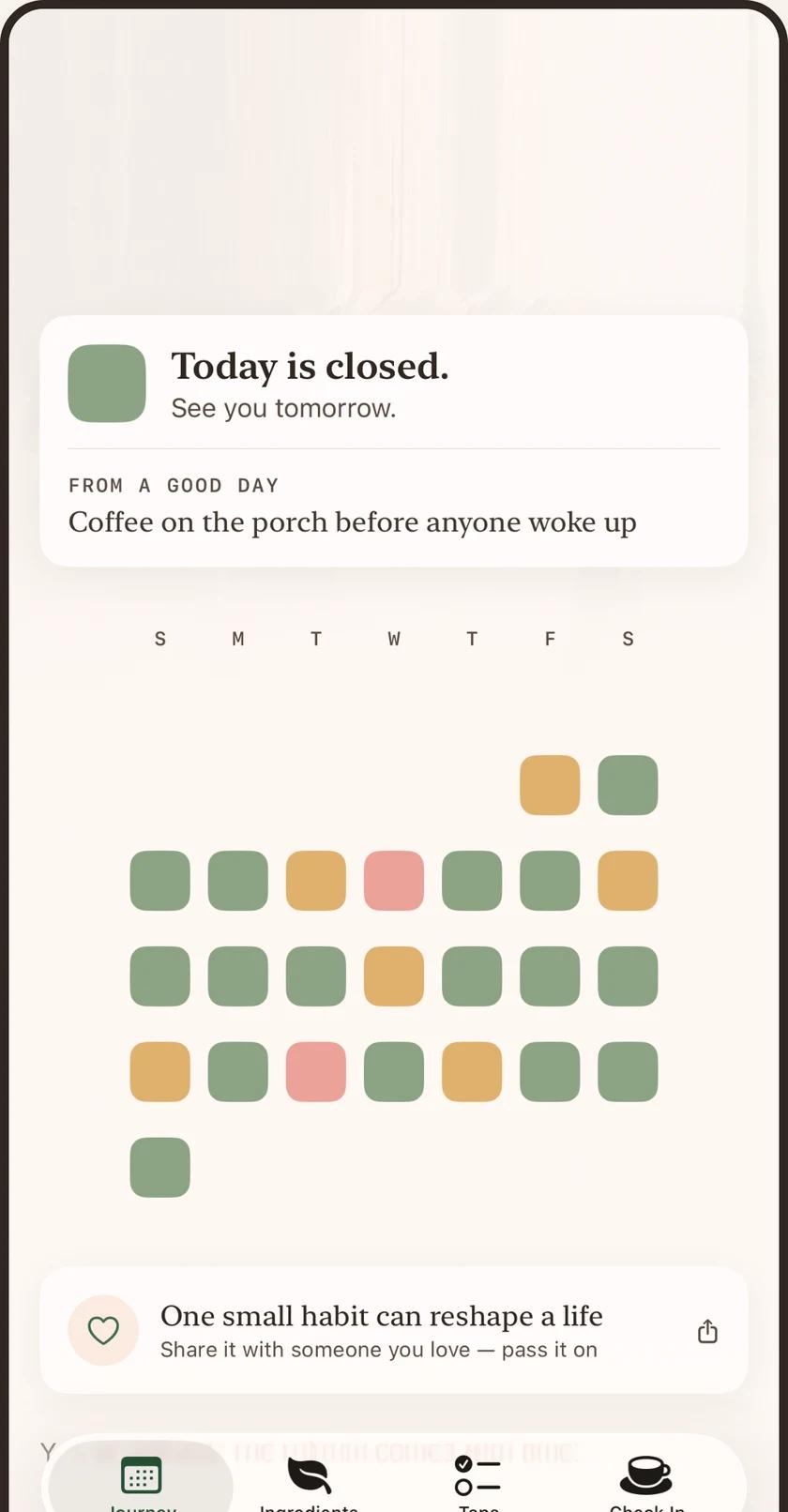
Muscle is kept by ordinary weeks: the strength sessions you actually do, the nights you actually sleep. HealthBrew's nightly close takes about a minute and, after a few weeks, shows your pattern. Membership, cancel anytime.
Educational content, not medical advice. Sources, read as PubMed abstracts on 11 November 2026 (we did not read the full papers, except Cruz-Jentoft et al.): Cruz-Jentoft et al., Age and Ageing, 2019; Bhasin et al., Journal of the American Geriatrics Society, 2020; Petermann-Rocha et al., Journal of Cachexia, Sarcopenia and Muscle, 2022; Mayhew et al., Age and Ageing, 2019; Kitamura et al., Journal of Cachexia, Sarcopenia and Muscle, 2021; Batsis et al., Geriatrics & Gerontology International, 2023; Gao et al., Nutrients, 2021; Lv et al., BMJ Open, 2024; Kok et al., European Addiction Research, 2012; Hong and Bae, Nutrients, 2022; Yuan and Larsson, Metabolism, 2023; Piercy et al., JAMA, 2018; Watson et al., consensus statement of the American Academy of Sleep Medicine and Sleep Research Society, 2015.
Common questions
What is sarcopenia?
Sarcopenia is the loss of muscle strength and muscle mass that goes far enough to affect health. The European working group definition (Cruz-Jentoft et al., Age and Ageing, 2019) puts low muscle strength first, uses low muscle mass to confirm it, and treats poor physical performance, such as slow walking, as a sign it is severe. It is common in older adults but can start earlier.
How common is sarcopenia?
It depends on the definition. A review of 151 studies and 692,056 people (Petermann-Rocha et al., 2022) put it at 10% to 27% in adults 60 and older. Another review (Mayhew et al., Age and Ageing, 2019) found estimates from 9.9% to 40.4% depending only on the definition used.
Does sleep affect muscle loss?
In 5,036 Chinese adults aged 45 and older followed for four years (Lv et al., BMJ Open, 2024), sleeping under 6 hours a night went with a 22% higher risk of developing possible sarcopenia and a 27% higher risk of low grip strength, compared with 6 to 8 hours. Sleeping over 8 hours was not linked. The study is observational.
HealthBrew app
What do your own best days have in common?
HealthBrew is a habit tracker built by a physician. Close your day in about 60 seconds. After a few weeks, your AI companion shows you what your best days share.



Educational, not medical advice.
Building this into your own days? Habit Tracker App: How to Pick One You Will Keep
Related guides
Healthy-living advice, by email.