Five-Minute Practices for Stress: What the Trials Found
Small practices have been tested in randomized trials. The effects are real, modest, and about how days feel, not how many you get.
Healthspan is the years you live in good health, and part of that is how the days feel. A handful of very small practices have been put through randomized trials. Here is what they found, including where they found nothing.
Five minutes of breathing
A remote randomized study had people do one of three breathing exercises, or mindfulness meditation, for five minutes a day for a month (Balban 2023, Cell Reports Medicine). One of the breathing exercises was cyclic sighing, which puts the weight on long exhales.
Breathing, and cyclic sighing most of all, improved mood more than meditation did. It also lowered breathing rate more. The abstract we read does not give the number of participants, so we cannot tell you how big the study was.
A 15-minute walk, looking for awe
Sixty healthy older adults took a 15-minute outdoor walk once a week for eight weeks (Sturm 2022, Emotion). Half were asked to look for awe on the walk: something vast, something they did not fully understand. The other half just walked.
The awe walkers reported more joy and more warmth toward other people during the walks. Away from the walks, their daily distress fell more over time.
Here is the part most write-ups skip. Anxiety, depression and life satisfaction, measured before and after, did not change in either group.
Savoring
Savoring means deliberately staying with a good moment instead of moving past it. A 2026 analysis pooled 20 randomized trials and 4,805 people (Chen 2026, Applied Psychology: Health and Well-Being). The overall effect on emotional outcomes was 0.51 on a standardized scale. By a common rule of thumb, 0.2 is small, 0.5 is moderate and 0.8 is large.
The estimates looked larger when savoring was compared with doing nothing than when it was compared with another activity. That difference did not reach significance, but it is worth knowing.
The big picture: which practice wins?
Mostly, none of them does.
One review covered 419 randomized trials and 53,288 people (van Agteren 2021, Nature Human Behaviour). Mindfulness and programs combining several positive-psychology exercises did best. The authors' own verdict: effects were moderate at best, and the quality of evidence was generally low to moderate.
A second review compared the approaches against each other in adults with no diagnosed condition: 183 trials, 22,811 people (Wilkie 2026, Nature Human Behaviour). Mindfulness, compassion practices, single positive-psychology exercises, yoga and exercise all landed in the same range (0.41 to 0.49), with no significant differences between them. Programs that combined exercise with a psychological practice had the largest effect (0.73). Nature-based programs were not significantly better than controls. Risk of bias was often moderate to high.
So pick the one you will do. The research does not crown a winner.
Two results that do not transfer directly
A 30-minute online module that taught students to see stress as something they could use improved their stress responses across six randomized experiments, the largest with 2,717 students (Yeager 2022, Nature). Everyone in it was a secondary or post-secondary student in the United States.
In 242 patients who had just had a coronary procedure, adding a positive-mood and self-affirmation component to standard education helped more of them reach an activity goal at 12 months: 54.9% against 37.4% (Peterson 2012, Archives of Internal Medicine). These were heart patients in a supervised program.
Both are interesting. Neither is a study of you.
What to do tonight, with a number
Set a timer for 5 minutes and breathe with long exhales. In through the nose, then out slowly, so the out-breath is clearly longer than the in-breath. Five minutes a day is the dose in the trial. The abstract does not spell out the exact pattern, so that description is ours. If you feel dizzy, stop and breathe normally.
Once this week, walk 15 minutes outside and look for one thing bigger than you. A tree, the sky, a building. That is the awe walk.
Before bed, stay with one good thing from today for 2 minutes. The two minutes is ours.
And keep the basics. None of this replaces at least 7 hours of sleep (Watson 2015).
The honest part
None of these studies measured how long anyone lived. They measured mood, distress and self-reported well-being over weeks. The effects are modest, the evidence quality is mixed by the researchers' own account, and people in these trials know which practice they are doing, which can color their answers.
These are practices for ordinary stress. They are not treatment. If you feel anxious or low most days, please talk to a doctor or a counselor. In the US you can call or text 988 at any hour.
Where HealthBrew fits
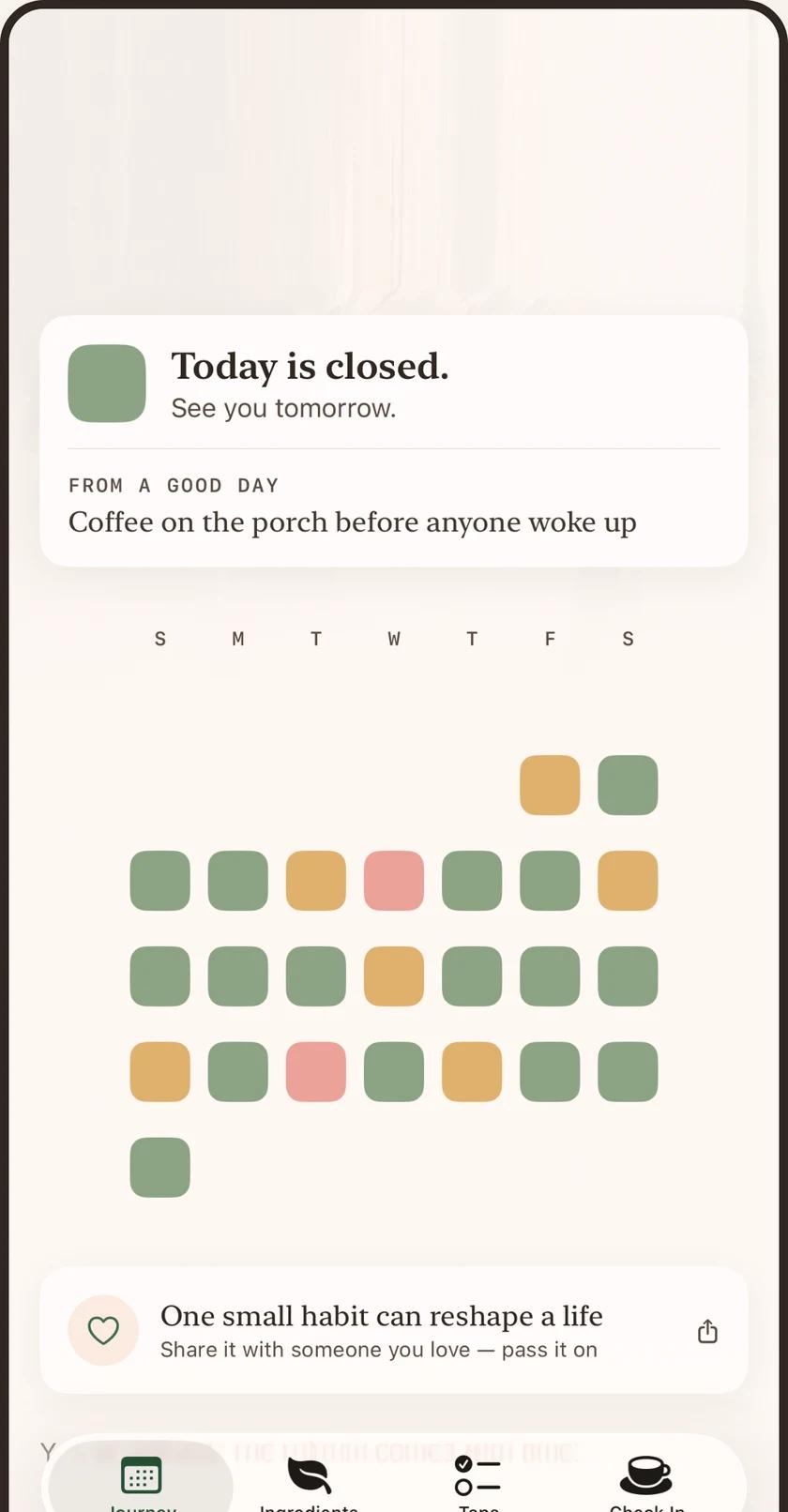
Five minutes only helps on the days you do it. HealthBrew's nightly close takes about a minute and, after a few weeks, shows your pattern. Membership, cancel anytime.
Educational content, not medical advice. Sources, read as PubMed abstracts on 10 November 2026 (we did not read the full papers): Balban et al., Cell Reports Medicine, 2023; Sturm et al., Emotion, 2022; Chen et al., Applied Psychology: Health and Well-Being, 2026; van Agteren et al., Nature Human Behaviour, 2021; Wilkie et al., Nature Human Behaviour, 2026; Yeager et al., Nature, 2022; Peterson et al., Archives of Internal Medicine, 2012; Watson et al., consensus statement of the American Academy of Sleep Medicine and Sleep Research Society, 2015.
Common questions
Does five minutes of breathing a day reduce stress?
In a remote randomized study (Balban et al., Cell Reports Medicine, 2023), five minutes a day of breathing exercises for a month, especially cyclic sighing with long exhales, improved mood and lowered breathing rate more than five minutes of mindfulness meditation. The abstract does not report the number of participants, and the study did not measure long-term health.
What is an awe walk?
It is a walk on which you deliberately look for things that feel vast or hard to take in. In a randomized trial of 60 healthy older adults (Sturm et al., Emotion, 2022), a weekly 15-minute awe walk for eight weeks went with more joy during walks and a larger drop in daily distress than an ordinary walk. Anxiety, depression and life satisfaction did not change in either group.
Which well-being practice works best?
No single one clearly wins. A 2026 comparison of 183 randomized trials and 22,811 adults (Wilkie et al., Nature Human Behaviour) found that mindfulness, compassion practices, positive-psychology exercises, yoga and exercise had similar moderate effects, with no significant differences between them. Programs combining exercise with a psychological practice had the largest effect.
HealthBrew app
What do your own best days have in common?
HealthBrew is a habit tracker built by a physician. Close your day in about 60 seconds. After a few weeks, your AI companion shows you what your best days share.



Educational, not medical advice.
Building this into your own days? Habits for More Energy After 40: What to Track
Related guides
Healthy-living advice, by email.