Healthspan vs Lifespan: Americans Live 12 Years Longer Than They Stay Healthy
The gap between the two is 9.6 years worldwide and 12.4 in the United States. Five ordinary habits go with a much smaller one.
Lifespan is how long you live. Healthspan is how many of those years you spend in good health. The two numbers are drifting apart, and the United States has the widest gap anyone has measured.
The gap, in numbers
A 2024 analysis in JAMA Network Open (Garmany 2024) used World Health Organization data for 183 member states across two decades. Worldwide, people now live 9.6 years longer than they stay healthy. In the United States the gap is 12.4 years, the largest in the study. Women's gap was 2.4 years wider than men's on average. The paper ties the gap to the rise of noncommunicable disease: heart disease, diabetes, cancer and the like.
These are national averages built from country statistics. Nobody was followed as an individual. The study tells you how big the problem is. It does not tell you what one person can do about it.
What goes with a smaller gap
For that you need studies that follow people. The best known come from two long US cohorts of health professionals: the Nurses' Health Study and the Health Professionals Follow-up Study.
In 2020 a team reported in The BMJ on 73,196 women and 38,366 men from those cohorts (Li 2020). They counted five things: never smoking, a body mass index of 18.5 to 24.9, at least 30 minutes a day of moderate to vigorous activity, moderate alcohol intake, and a higher diet quality score. Then they asked how many years people lived after 50 without diabetes, cardiovascular disease or cancer.
- Women with four or five of the habits: 34.4 more years without those diseases. Women with none: 23.7.
- Men with four or five: 31.1 years. Men with none: 23.5.
An earlier paper from the same cohorts (Li 2018, Circulation, 78,865 women and 44,354 men, 42,167 deaths over up to 34 years) looked at total life expectancy at 50. Women with all five habits were projected to live 43.1 more years, against 29.0 with none. For men it was 37.6 against 25.5.
So the habits that go with a longer life also go with more of that life spent without three major diseases. That is the healthspan argument in one line.
How you feel belongs on the list
The English Longitudinal Study of Ageing followed 9,761 people, average age 64, for up to 10 years (Zaninotto 2019, JAMA Network Open). Well-being here meant enjoying life and having no significant depressive symptoms. A woman of 50 who scored high could expect 31.4 more years without disability, against 20.8 for a woman who scored low. A man of 50 could expect 20.8 years without chronic disease, against 11.4. The team adjusted for wealth and for living with a partner.
Read that carefully. People who are already getting sick tend to feel worse, so some of this runs backward. It is still a large difference, and it is one no lab test picks up.
What to do tonight, with a number
Walk for 15 minutes. In a study of 416,175 adults in Taiwan (Wen 2011, The Lancet), people who averaged about 15 minutes of exercise a day had a 14% lower risk of dying during follow-up than inactive people, and a life expectancy 3 years longer. Each extra 15 minutes a day went with a further 4% lower risk. Exercise was self-reported.
Then score yourself out of five. Not smoking, 30 minutes of activity, what you ate, alcohol, body weight. Write the number down. Pick the one you can move this week.
The honest part
Every study on this page is observational. Nobody was assigned to a habit. People who keep five healthy habits differ from people who keep none in income, education, and health they were born with, and adjustment never removes all of that. The US cohorts are nurses and health professionals, mostly white, who know more about health than most.
The studies scored moderate drinking as the low-risk category. That is how they counted it. It is not a reason to start drinking.
And the life expectancy figures are projections from life tables. They describe groups. They are not a promise to any one person.
Where HealthBrew fits
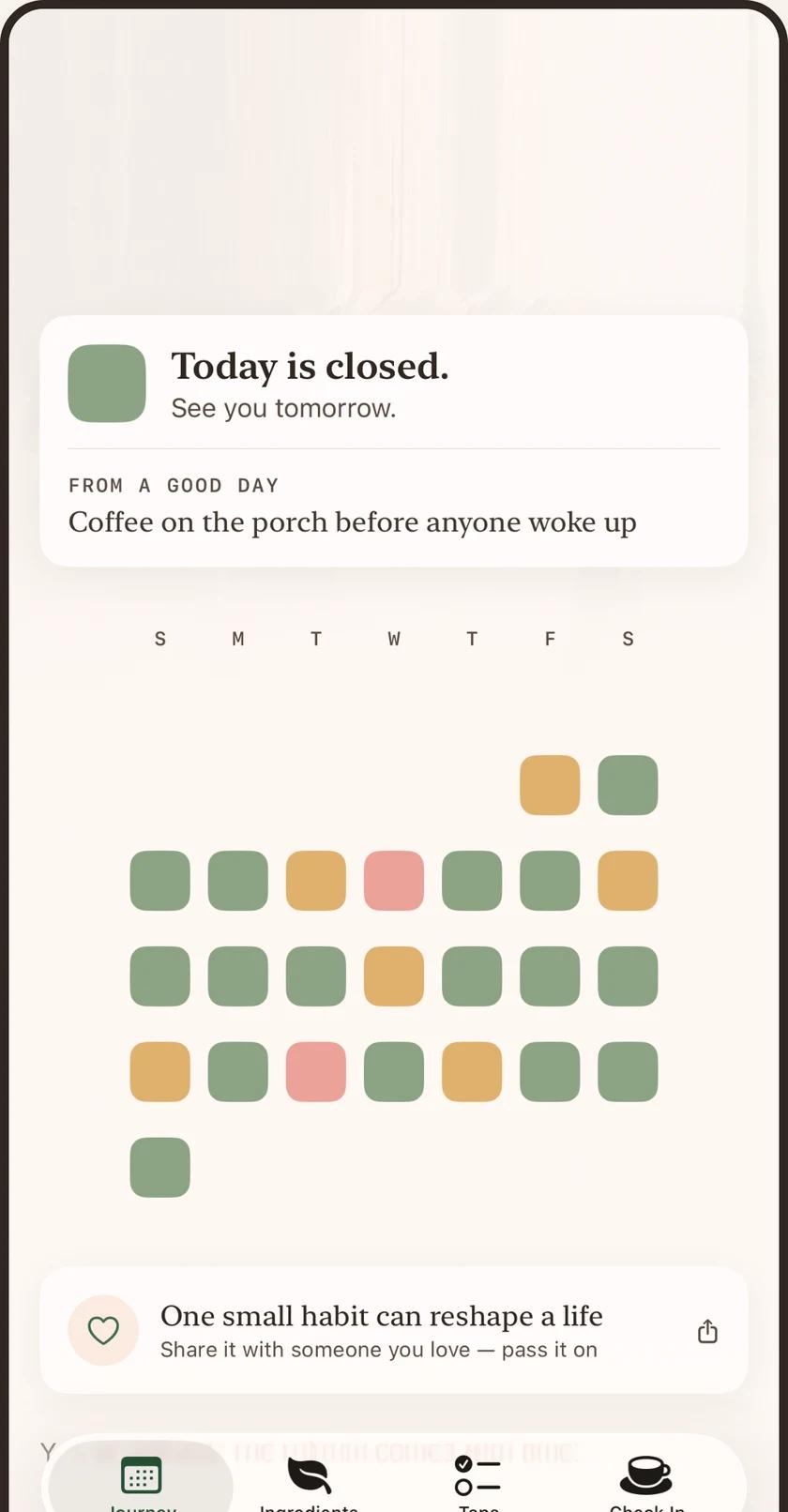
A score out of five tells you where you stand today. What moves it is what you do on ordinary days. HealthBrew's nightly close takes about a minute and, after a few weeks, shows your pattern. Membership, cancel anytime.
Educational content, not medical advice. Sources, read as PubMed abstracts on 10 November 2026 (we did not read the full papers): Garmany, JAMA Network Open, 2024; Li et al., The BMJ, 2020; Li et al., Circulation, 2018; Zaninotto et al., JAMA Network Open, 2019; Wen et al., The Lancet, 2011.
Common questions
What is the difference between healthspan and lifespan?
Lifespan is the number of years you live. Healthspan is the number of those years lived in good health. A 2024 analysis of World Health Organization data for 183 countries (Garmany, JAMA Network Open) put the gap between them at 9.6 years worldwide and 12.4 years in the United States.
How big is the healthspan gap in the United States?
It is 12.4 years, the largest of the 183 countries in the 2024 JAMA Network Open analysis. That is a national average from country statistics, not a prediction for any one person.
What habits are linked to a longer healthspan?
In two US cohorts of 73,196 women and 38,366 men (Li et al., The BMJ, 2020), people at 50 with four or five of these lived about 8 to 11 more years without diabetes, cardiovascular disease or cancer than people with none: never smoking, a body mass index of 18.5 to 24.9, at least 30 minutes of daily activity, moderate alcohol intake, and a higher diet quality score. The study is observational, so it shows a link, not proof of cause.
HealthBrew app
What do your own best days have in common?
HealthBrew is a habit tracker built by a physician. Close your day in about 60 seconds. After a few weeks, your AI companion shows you what your best days share.



Educational, not medical advice.
Building this into your own days? Habit Tracker App: How to Pick One You Will Keep
Related guides
Healthy-living advice, by email.