How Much Exercise to Live Longer: What the First 15 Minutes Buy
The guideline says 150 minutes a week. The biggest step in the data is the one from nothing to a little.
Most people know the guideline: 150 minutes a week. Most people also do not hit it. The useful question is what happens below that line.
Fifteen minutes a day
A Taiwanese study followed 416,175 adults for an average of eight years (Wen 2011, The Lancet). People who exercised about 92 minutes a week, roughly 15 minutes a day, had a 14% lower risk of dying during the study than people who were inactive. Their life expectancy was three years longer. Each extra 15 minutes a day went with a further 4%.
The exercise was self-reported on a questionnaire. Still, it is hard to find a cheaper three years anywhere in the research.
Steps: the curve bends at 5,000 to 7,000
A 2025 review pooled 57 studies from 35 cohorts, all using step counts from devices (Ding 2025, The Lancet Public Health). Compared with 2,000 steps a day, 7,000 steps went with a 47% lower risk of dying during follow-up, across 14 studies. It also went with lower rates of cardiovascular disease, dementia, depressive symptoms and falls.
For several outcomes, including death from any cause, the curve bent at around 5,000 to 7,000 steps. More steps still helped, just less per step. The 10,000 number is fine. It is not where the evidence points.
Three short bursts
Some people never exercise on purpose. UK researchers put wearables on 25,241 of them, average age 62, and counted short bursts of hard effort in normal life: climbing stairs fast, hurrying for a bus (Stamatakis 2022, Nature Medicine). Over about seven years, 852 died.
People who logged three bursts a day, each lasting one or two minutes, had a 38% to 40% lower risk of death from any cause than people who logged none.
Fitness itself
A study of 750,302 US veterans aged 30 to 95 measured fitness on a treadmill and followed them for a median of 10 years (Kokkinos 2022, Journal of the American College of Cardiology). The least fit fifth had about four times the risk of dying of the fittest group. There was no sign of extra risk at very high fitness. The authors wrote that being unfit carried more risk than any cardiac risk factor they examined. Only 45,232 of the veterans were women.
Strength: about 90 minutes a week
Three US cohorts, 147,374 people followed for up to 30 years, reported how much resistance training they did (Zhang 2026, British Journal of Sports Medicine). People doing 90 to 119 minutes a week had a 13% lower risk of death than people doing none, after accounting for aerobic exercise. Above 120 minutes a week there was no further gain. Risk was lowest in people who paired strength work with plenty of aerobic exercise, and in the most aerobically active people whatever their strength training.
Starting late still counts
Researchers followed 9,518 women aged 65 and older, and saw 7,553 of them again about six years later (Gregg 2003, JAMA). Women who had gone from sedentary to active had a 48% lower risk of death than women who stayed sedentary. The link was weaker in women 75 and older and in those in poor health.
And strength comes back at almost any age. In a randomized trial, 100 frail nursing home residents, average age 87, did ten weeks of resistance training or did not (Fiatarone 1994, NEJM). Muscle strength rose 113% in the exercisers and 3% in the others. Walking speed rose 11.8% and fell 1.0%.
How it feels, and one hard trial
A pooled analysis of 81 randomized studies with 7,050 people found that exercise lowered fatigue and raised energy, by small to moderate amounts (Wender 2022, Frontiers in Psychology).
Almost everything above is observational. One recent randomized trial is not. It assigned 889 people who had finished surgery and chemotherapy for colon cancer to a three-year structured exercise program or to health education (Courneya 2025, NEJM). At eight years, 90.3% of the exercise group was alive, against 83.2%. Muscle and joint problems were also more common with exercise, 18.5% against 11.5%. These were patients in a supervised program. It is not general advice, and anyone in treatment should plan exercise with their own care team.
What to do tonight, with a number
Walk for 15 minutes after dinner. Brisk enough that talking takes a little effort. That is the dose in the Taiwanese study.
Look at your step count. If it is under 5,000, the next 2,000 are the most valuable steps you can take.
Put two strength sessions in this week's calendar, 45 minutes each. That is the 90 minutes.
The honest part
Nobody in the big studies was assigned to exercise. Healthy people move more, and sick people move less, so some of the difference is health causing movement and not the reverse. The percentages are relative risks for groups. They do not say what will happen to you. We read the abstracts, not the full papers.
If you have a heart condition, chest pain or dizziness with effort, talk to your doctor before you push harder.
Where HealthBrew fits
The research says a little, done most days, counts for a lot. The hard part is most days. HealthBrew's nightly close takes about a minute and, after a few weeks, shows your pattern. Membership, cancel anytime.
Educational content, not medical advice. Sources, read as PubMed abstracts on 10 November 2026 (we did not read the full papers): Wen et al., The Lancet, 2011; Ding et al., The Lancet Public Health, 2025; Stamatakis et al., Nature Medicine, 2022; Kokkinos et al., Journal of the American College of Cardiology, 2022; Zhang et al., British Journal of Sports Medicine, 2026; Gregg et al., JAMA, 2003; Fiatarone et al., NEJM, 1994; Wender et al., Frontiers in Psychology, 2022; Courneya et al., NEJM, 2025.
Common questions
What is the minimum amount of exercise linked to a longer life?
In a study of 416,175 Taiwanese adults (Wen et al., The Lancet, 2011), about 15 minutes a day, or 92 minutes a week, went with a 14% lower risk of death and a life expectancy three years longer than being inactive. Each extra 15 minutes a day went with a further 4%. The exercise was self-reported and the study is observational.
How many steps a day do you need?
A 2025 review of 57 studies (Ding et al., The Lancet Public Health) found that 7,000 steps a day, compared with 2,000, went with a 47% lower risk of death from any cause. For several outcomes the curve bent at around 5,000 to 7,000 steps, so the first few thousand steps carry the most benefit.
How much strength training is enough?
In 147,374 US adults followed for up to 30 years (Zhang et al., British Journal of Sports Medicine, 2026), 90 to 119 minutes of resistance training a week went with a 13% lower risk of death than none, and there was no further gain above 120 minutes a week. Risk was lowest in people who paired resistance training with plenty of aerobic exercise.
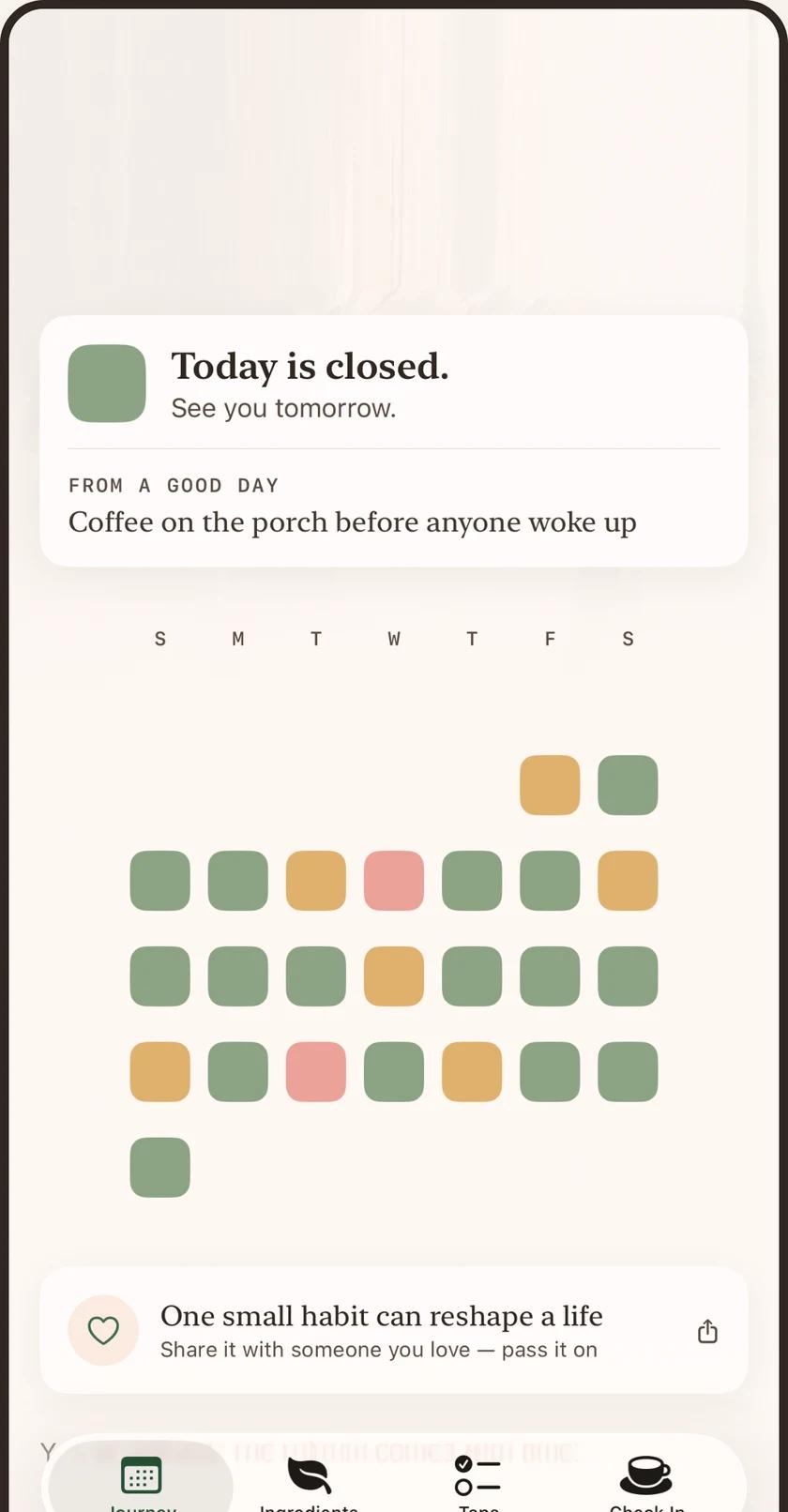
HealthBrew app
What do your own best days have in common?
HealthBrew is a habit tracker built by a physician. Close your day in about 60 seconds. After a few weeks, your AI companion shows you what your best days share.



Educational, not medical advice.
Building this into your own days? Habit Tracker App: How to Pick One You Will Keep
Related guides
Healthy-living advice, by email.