Eliud Kipchoge Training Routine (2026): What Is Actually Written in the Diary
Everyone repeats that he writes every run down. Almost nobody says what is on the page, or that the most-quoted line about the diary has no traceable interview behind it.
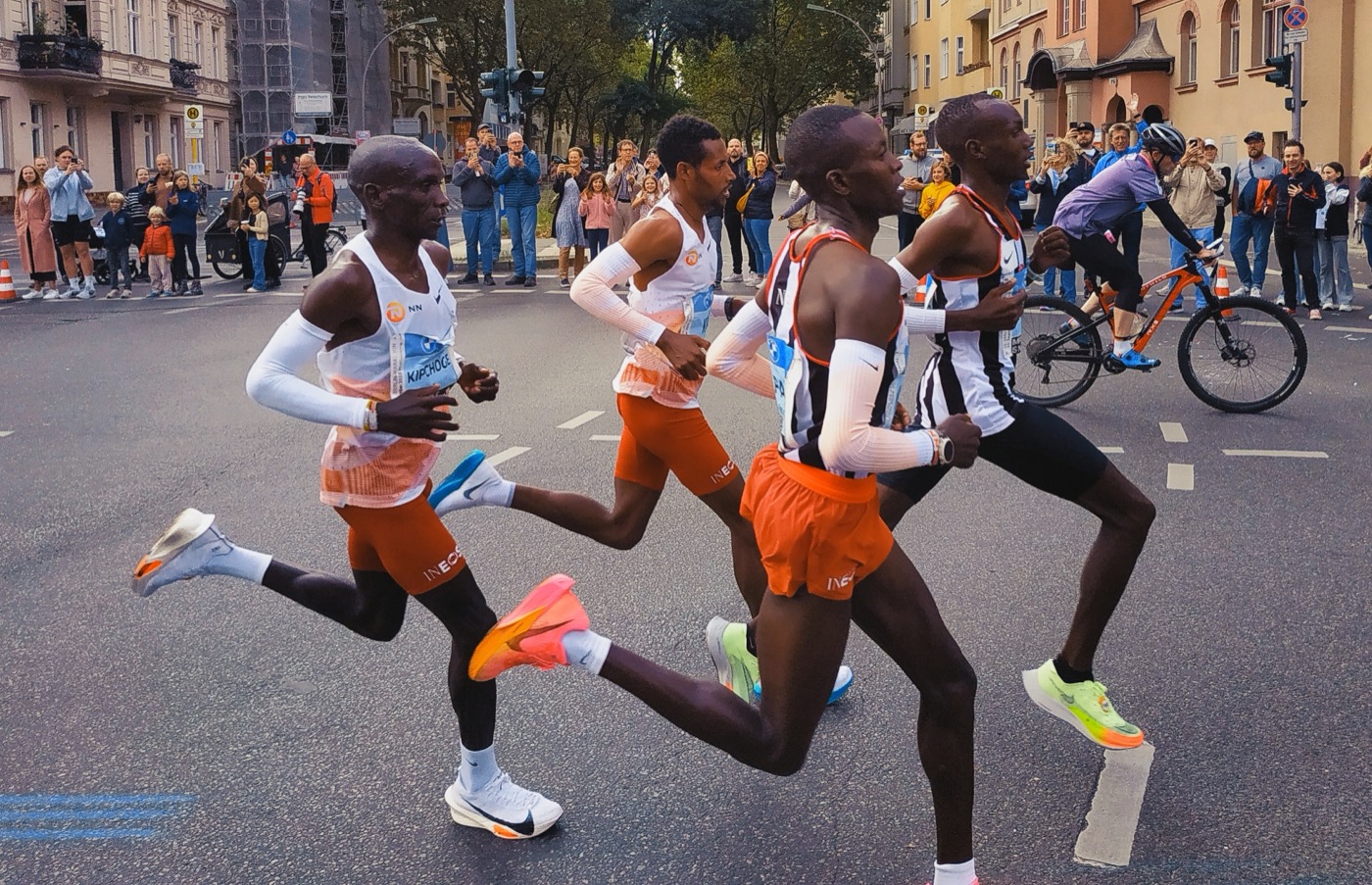
In November 2017, Sports Illustrated put a simple assumption to Eliud Kipchoge. The interviewer said he assumed Kipchoge kept a detailed training log. The answer was four words and a number: "Absolutely. For the last 14 years, I have 14 notebooks with all my workouts."
The follow-up was a joke about buying one. Kipchoge laughed and said they were not for sale.
That short exchange is the firmest thing in print about the most repeated habit in distance running. We already have a page on the habit itself, why writing every session down works. This page covers what that one does not: what is actually on the page, when he writes, what happens to the old books, how the easy days are structured, and which famous diary quote falls apart when you look for its source.
The habit, precisely
- One book per year, since 2003. The arithmetic is his own: 14 notebooks over 14 years, said in 2017. That dates the start to around 2003, when he was still a teenaged track runner, a full decade before his marathon debut in Hamburg in April 2013. He was logging long before there was anything impressive to log.
- The entries are inventory, not prose. Reporting on the notebooks describes short factual lines, the distance, the times, the massage and gym work, the shoes he wore and what he thought of them, and a note on how the session felt. This is a parts list of a day, not a diary in the emotional sense.
- He writes session by session, not at the end of a block. The value of a note about how a run felt collapses within hours. By Friday you have quietly rewritten Tuesday in your head.
- The old books are kept and read back at season's end. He does not throw them out; the stack goes back to the start. The point of keeping fourteen of them is that a season can be compared with the one before it.
One honest caveat on that list. Points 2 and 4 come from reporting about the notebooks, not from a dated interview in his own words. We could reach the Sports Illustrated exchange and read it in full; the descriptions of what is inside the books are journalists' accounts. Treat item 1 as verified and items 2 and 4 as reported, not verified.
The most-quoted diary line has no source
Search for Kipchoge and journaling and you will hit this sentence within about ten seconds: "I have kept a training diary to record my training plans and my feelings and emotions for a long time."
It is on quote-aggregator sites by the dozen, and in newsletters and motivational round-ups. It is not, as far as we can find, in any interview.
We looked for it in the Sports Illustrated November 2017 profile that carries the 14-notebook exchange, in the INEOS 1:59 Challenge "Eliud's Diaries" collection on the challenge's own site, in the sources cited by his Wikipedia article, and across the running-press coverage of his training. The 2017 profile has the notebook exchange and nothing resembling this sentence. The INEOS diaries are entries he supplied to the campaign, as told to a writer, they say nothing about how he keeps a diary. Every other trail runs into a quote database with no citation.
We are not saying he never said it. We are saying we cannot find where. And it matters more than it sounds: the untraceable version makes the notebook sound like a feelings journal, while the one sourced quote makes it sound like a workshop log of workouts. Those are different habits, and only one of them is documented.
The easy days are the routine
The diary is half the story. The other half is what it records, and the surprise is how gentle most of it is.
The most quoted description of his effort control is his own: "I try not to run 100 percent," followed by "I perform 80 percent on Tuesday, Thursday, and Saturday and then at 50 percent Monday, Wednesday, Friday, and Sunday." Read that carefully, because the internet reads it wrong. Those are percentages of effort on given days, not a rule that 80 percent of his running is easy. Four of his seven days run at roughly half effort. Three are hard.
Be exact about where it comes from: Cathal Dennehy's Outside reporting from inside the Kaptagat camp in 2021, republished by David Roche. We read Roche's version, which reproduces the full quote with its quotation marks intact. Dennehy's original sits behind a login wall that we hit every time we tried it, so the quote is verified in the syndicating article and reported, not verified at the original.
What his coach Patrick Sang does on those easy days is plainer still. Coverage of a Kaptagat long run describes Sang not prescribing paces at all, asking his athletes to set an honest pace, go on how they feel, and pick it up toward the end if they can. Any recreational runner could follow that tomorrow, and it is the opposite of what most people do with a watch.
What the science says
Recording your own behavior is the single most effective technique in the behavior-change literature. A meta-regression of 122 evaluations of healthy-eating and physical-activity interventions found self-monitoring to be the most effective individual technique measured, and found that programs combining self-monitoring with at least one other self-regulation technique, goal-setting, feedback, review, outperformed the rest by a clear margin, with effect sizes of 0.42 against 0.26 (Michie et al. Health Psychology, 2009). Kipchoge's practice is that combination exactly: record daily, review at season's end.
Mostly-easy training beat every alternative in the one trial that tested them head to head. Stöggl and Sperlich randomly assigned 48 well-trained endurance athletes : runners, cyclists, triathletes and cross-country skiers, with 8 to 20 years of competition behind them, to nine weeks of one of four intensity distributions (Frontiers in Physiology, 2014). The polarised group, running 68 percent of sessions easy, 6 percent at threshold and 26 percent hard, gained 11.7 percent in peak oxygen uptake and 17.4 percent in time to exhaustion. A high-intensity group gained less. The threshold group and the high-volume group, statistically, gained nothing.
Be careful how far you carry that. These were well-trained athletes, not beginners, over nine weeks, on laboratory measures rather than race times. The authors flagged the roughly 11 percent gain as unusually large and called for long-term studies before generalising. What it supports is modest and useful: spending most sessions comfortably easy is not a soft option, and grinding every run at moderate-hard produced nothing.
And the honest limit on the diary evidence. No study has shown that writing runs in a notebook makes anyone faster. The Michie result is about behavior change, whether you keep doing the thing, not about performance. That is still the useful claim, because the reason most training plans fail is that they stop being followed.
Why it works when it works
The notebook does one thing memory cannot: it holds the boring middle. You remember your best run and your worst one. The 300 ordinary sessions between them are where the pattern lives, and they are gone by Thursday unless something wrote them down.
The old books matter for the same reason. A single season tells you almost nothing, every athlete has a bad autumn. Fourteen of them tell you whether it is a pattern or a Tuesday.
How to run it yourself, starting tonight
- Write tonight's entry in four fields and nothing else: what you did, one number, what you wore or used, one line on how it felt. Four fields survives a bad week. Ten fields dies in three.
- Do it within two hours of the session, not at bedtime and not at the weekend. How something felt is the field that decays fastest, and it is the field that later explains everything.
- Make four of your seven days deliberately easy, conversational, honest effort, no watch pressure. That is Kipchoge's own split (three harder days, four at about half effort), and it is the direction the 48-athlete trial pointed.
- Put a 15-minute review in the calendar for the last Sunday of every month. Read the month back and answer one question: what came before the best week? That review is the half of the habit almost everyone skips, and it is the half the 122-study meta-regression says does the work.
- Start a new book on January 1 and keep the old one. The comparison across years is the entire payoff, and it only exists if you did not throw the last one away.
The mistakes that kill this habit
Turning it into a feelings journal because of a quote nobody can source. The line about "feelings and emotions" is untraceable. The documented practice is a short factual record of sessions. A page of introspection every night is a heavier habit that will fail sooner.
Logging only the good sessions. A record of your best days is a highlight reel. Everything you need, what precedes the injuries, what precedes the bad stretches, lives in the entries you least feel like writing.
Writing and never reading. A log you never read back is storage, not feedback. Kipchoge's books get read at the end of a season. Without the read-back you have a filing cabinet.
Running all seven days at moderate-hard. This is close to the distribution the Stöggl and Sperlich threshold group ran, and it was one of the two groups that gained nothing across nine weeks. Hard days are only hard because most days were not.
Copying the volume instead of the method. He runs an elite professional's mileage in a camp built around him, with a coach, a physio and no other job. That part is his life, not a lesson. The four-field entry and the monthly read-back are the parts that transfer.
Where HealthBrew fits
HealthBrew is that four-field entry, done in about a minute at the end of the day, what you did, how it went, a couple of honest lines. Your AI companion coach reads your months back for the patterns you would never hold in your head. Membership, cancel anytime.
Educational and behavioral content, not medical or training advice. Verified: the 14-notebook exchange (Sports Illustrated, November 2017) and the effort-percentage quote as reproduced in full by David Roche from Cathal Dennehy's Outside reporting, the original of which sits behind a login wall we could not get past. Reported, not verified: the contents of the notebooks. We do not know where they are kept and say nothing about it. Untraceable: the widely quoted "training plans and my feelings and emotions" line. We picked a man who won; thousands of runners keep the same notebook and stay unknown.
Common questions
What does Eliud Kipchoge actually write in his training diary?
The one thing verified in his own words is how many books there are: he told Sports Illustrated in November 2017, "Absolutely. For the last 14 years, I have 14 notebooks with all my workouts." Reporting on those notebooks describes short factual entries, distance, times, gym and massage work, the shoes he wore and what he thought of them, and a note on how the session felt. That description is a journalists' account rather than a dated quote from him, so treat it as reported rather than verified. The much-repeated line about recording his "feelings and emotions" appears only on quote-aggregator sites; we could not find it in any named interview.
Does Kipchoge really train 80 percent easy?
Not in the way it is usually repeated. His quoted description is about effort on given days: "I try not to run 100 percent. I perform 80 percent on Tuesday, Thursday, and Saturday and then at 50 percent Monday, Wednesday, Friday, and Sunday." That is four easy days and three hard ones, not a rule that 80 percent of his mileage is easy. The quote is reproduced in full by David Roche, credited to Cathal Dennehy's Outside reporting from the Kaptagat camp; the original is paywalled and we could not read it directly.
Is there evidence that mostly-easy running works?
For trained athletes, yes, from one head-to-head trial. Stoggl and Sperlich randomized 48 well-trained endurance athletes to nine weeks of four different intensity distributions (Frontiers in Physiology, 2014). The polarised group, 68 percent easy, 6 percent threshold, 26 percent hard, gained 11.7 percent in peak oxygen uptake and 17.4 percent in time to exhaustion, while the threshold and high-volume groups gained nothing significant. The limits matter: these were experienced athletes, the outcomes were laboratory measures rather than race times, and the authors themselves called for long-term studies before generalising.
Start Compounding Your Habits Tonight.
Use the free reflection generator to log your day. Let your AI companion coach help you find your baseline and have more days you would want again.
Produce OutcomesRelated guides
Want more days like theirs — measured on your own life?
HealthBrew is a physician-built longevity habit tracker. Close your day in about 60 seconds; your AI companion coach finds what your best (“green”) days have in common. Educational self-reflection — not medical advice.
Close tonight · ~60 seconds