Write Every Session Down — The Kipchoge Notebook Method
One notebook a year, twenty years of them, every run written down by hand. Then 1:59:40. The log isn’t a diary. It’s how he decides what to do next.
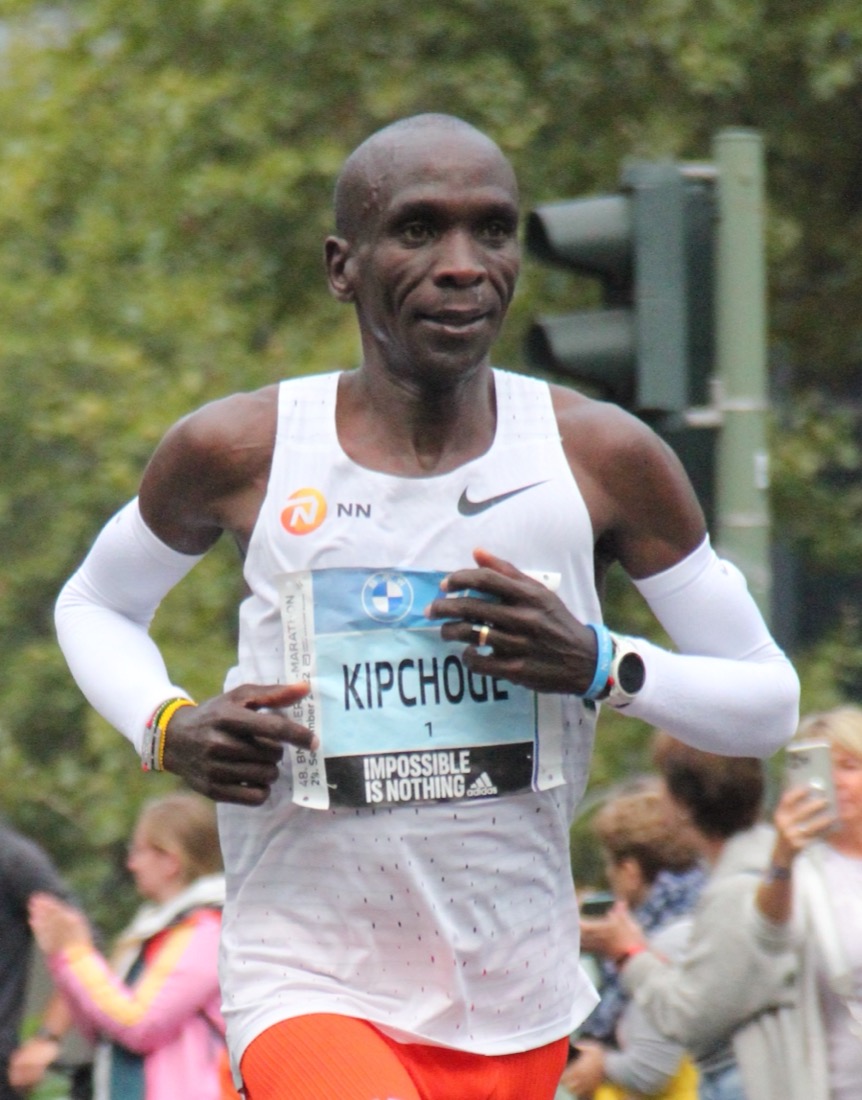
On October 12, 2019, in Vienna, Eliud Kipchoge covered the marathon distance in 1:59:40 — the first human being to run 26.2 miles in under two hours. It was a special event, run outside record rules, with rotating pacers; Kipchoge calls it his moon landing, and no one has repeated it.
Behind the moonshot sits the plainest habit in sport. Since 2003, Kipchoge has handwritten every training session in a simple notebook — the run, the times, the sleep, the shoes, how it felt. One notebook per year. More than twenty of them now, stacked in Kaptagat, Kenya, where he still lives in a training camp, does his chores, and writes his evenings down.
His logic, in his own words, is operational: what you write down, you can go back to. The notebook shows what worked. So he does it again.
If you want the detail rather than the principle — what is actually written on the page, what happens to the old books, how the easy and hard days are split, and the most-quoted diary line that turns out to have no traceable source — that is a separate page: what is actually written in Kipchoge's diary.
A fair objection, before the science: every elite runner logs training, and only one of them ran 1:59. The notebook didn't beat the field — a once-a-generation engine and world-class coaching did. What the notebook shows is what a twenty-year feedback loop looks like when someone actually reads it back. That loop is the copyable part.
The habit, precisely
- Everything gets recorded, immediately. Every session, same day, no exceptions — including the ordinary ones. Twenty years of ordinary entries is exactly what makes the log useful.
- By hand, in one place. One notebook, one year. No jumping between apps, no scattered notes. The slowness of paper actually helps: writing by hand forces a few seconds of honest review.
- It gets read, not just written. The notebook is a feedback instrument. Patterns — which weeks precede great races, which precede injuries — only exist if the entries accumulate in one reviewable place.
What the science says about writing it down
Self-monitoring is the most reliably effective behavior-change technique measured. A meta-analysis of 122 intervention studies found that programs built around self-monitoring — recording your own behavior — significantly outperformed those without it, and that combining self-monitoring with at least one other self-regulation technique — goals, feedback, review — outperformed the rest (Michie et al., Health Psychology, 2009). Kipchoge's notebook is a textbook implementation: record daily, review often.
Recording roughly doubled outcomes in the biggest real-world test we have — in its own domain. In a weight-loss trial with 1,685 participants (who, caveat, also received group support), those who kept daily food records lost approximately twice as much weight as those who kept none (Hollis et al., American Journal of Preventive Medicine, 2008). That result belongs to weight loss; the honest generalization is smaller and still real. The mechanism wasn't magic: the act of logging changes the behavior being logged, because you see it while it's still changeable.
The record is what makes progress visible — and visible progress sustains effort. Amabile's progress-principle research (nearly 12,000 diary entries; Amabile & Kramer, 2011) found small visible wins to be the strongest driver of sustained motivation. A training log gives you a visible win on days the stopwatch doesn't: the entry itself is proof the day counted.
Habits need a stable cue — and "same notebook, every evening" is one. Habit formation runs on repetition in a consistent context (Lally et al., European Journal of Social Psychology, 2010; a median of 66 days to automaticity among the 39 of 96 enrolled whose curves the model fitted). A set evening logging routine also gives you a fixed moment to check on every other habit you're building.
Why the log is the point, not a keepsake
Most people treat tracking as paperwork — a boring chore on top of the real work. Kipchoge treats the log as part of the work itself:
- It turns experience into facts. Feelings lie week to week; entries don't. "I always fall apart in week three" is invisible in memory and obvious on paper.
- It makes success repeatable. When you write down what came before a great day, you can go do those things again — instead of hoping the great day comes back on its own.
- It keeps score on the process, not the outcome. You can't control a race day. You can control whether today's entry exists. Twenty years of controllable entries produced the uncontrollable-looking result.
How to run the method yourself, starting tonight
- Pick one notebook or one app — and one only. Fragmented logs die. One place, one year.
- Log the day it happens, in under two minutes. What you did, one number that matters, one honest line about how it felt. Short enough to survive your worst day.
- Include the bad days. A log of only good days is a scrapbook. The pattern lives in the full record.
- Review weekly. Five minutes, once a week: what preceded the best day? The worst? That review is where the notebook starts coaching you.
- Attach it to a fixed evening moment so the logging itself becomes automatic.
The mistakes that kill the log
Logging only the good days. A record of your greatest hits is a scrapbook, not a tool. The pattern you need — what comes before the bad stretches — lives entirely in the entries you least feel like writing. Log the awful days the same way you log the great ones.
Making entries too rich to sustain. The log that asks for ten fields dies in week three. Kipchoge's entries are short; the power is in twenty years of them. Two minutes, three items, every day beats a beautiful template kept sporadically.
Writing without ever reading. A log you never read back is just storage. The weekly five-minute read-back — what came before the best day, the worst day — is where the notebook starts paying off. Put the review on the calendar or it won't happen.
Scattering the record. Three apps, two notebooks, and a notes file means no pattern is ever visible in one place. One log, one year, one home.
Stopping when things go badly. When a season falls apart, the instinct is to stop writing — the log feels like a list of your failures. But those are exactly the entries that make the next season better. The log isn't a report card. It's the record of what happened, good and bad.
Where HealthBrew fits
HealthBrew is a Kipchoge notebook for your life: a 60-second nightly close where the day gets written down — what you did, how it went, a few honest lines. Your AI companion coach reads your weeks back for the patterns you'd never remember on your own. What you write down, you can repeat. Membership, cancel anytime.
Educational content, not medical advice. The 1:59:40 was a special event outside record rules — the notebook is the part that generalizes.
Common questions
Does tracking really change behavior, or just measure it?
It changes it. Self-monitoring is among the most effective behavior-change techniques in the Michie et al. (2009) meta-analysis of 122 studies, and daily food-record keepers in the Hollis et al. (2008) trial lost roughly twice as much weight as non-keepers. Observation alters the behavior being observed — in your favor.
Paper notebook or app — does it matter?
What matters is one consistent place, logged the same day, and reviewed regularly. Kipchoge uses paper; the research is agnostic. Pick whichever you will still be using in month three.
What should a daily log actually contain?
Less than you think: what you did, one meaningful number, and one honest sentence about how it felt. Two minutes. Logs die because they ask for too much, not too little — a long run of short entries is worth more than any single detailed one.
Start Compounding Your Habits Tonight.
Use the free reflection generator to log your day. Let your AI companion coach help you find your baseline and have more days you would want again.
Produce OutcomesRelated guides
Take the habit with you.
Close your day in 60 seconds and watch the green days stack. On the App Store, and the price you see is the one for your country. Cancel anytime.