Loneliness and Longevity: What 2.2 Million People Show About Living Longer
People are on the longevity list next to food, sleep and exercise. Two small things have been tested in trials.
Most longevity lists stop at food, sleep and exercise. The research does not. Who you see, and how often, sits on the same list.
The number that started it
In 2010, researchers pooled 148 studies covering 308,849 people (Holt-Lunstad 2010, PLoS Medicine). People with stronger social relationships had 50% greater odds of being alive at the end of follow-up than people with weaker ones.
How they measured it mattered. The broadest measures of being woven into a social life showed the strongest link. Simply living alone or not showed the weakest.
Isolation and loneliness are two things
A 2023 analysis pooled 90 cohort studies and 2,205,199 people (Wang 2023, Nature Human Behaviour). It kept two ideas apart:
- Social isolation is having few contacts. It went with a 32% higher risk of death from any cause.
- Loneliness is feeling alone, whatever the count. It went with a 14% higher risk.
You can have one without the other. Someone with a full calendar can be lonely. Someone who lives alone can be fine.
Healthy years
A UK study of 277,489 adults looked at years lived in good health after 50 (Wang 2026, Nature Communications). Compared with people who were neither lonely nor isolated, people who were both had fewer years without physical disease: 2.4 fewer for women and 1.7 fewer for men. The gap in years without a mental disorder was larger, 3.7 for women and 5.8 for men.
One finding in it is worth holding on to. The years lost with isolation were fewer among people with healthier habits.
The good and the bad both count
A US study of 1,309 adults, average age 51, compared an epigenetic clock, which estimates biological age from chemical marks on DNA, with the social experiences people reported (Prigerson 2025, Scientific Reports). The good ones included marriage and going to social gatherings. The bad ones included a parent with a drug problem and time in jail. People whose social experiences were more positive than negative came out 2.85 years younger on that estimate, after adjustment. It was a single snapshot, so it cannot say which came first.
What has been tested
Most of this is observational. Two trials tried to do something about it.
A phone call. In Texas, 240 adults who received home-delivered meals were randomly assigned to get calls or not (Kahlon 2021, JAMA Psychiatry). The 16 callers were 17 to 23 years old and had been briefly trained in empathetic conversation. They called daily for the first five days, then at least twice a week, for four weeks. Loneliness improved by 1.1 points on a scale that runs from 3 to 9. Depression and anxiety scores improved too. On a second loneliness scale the difference did not reach significance. The trial ran during the COVID-19 pandemic.
One kind act a week. Three trials in the USA, the UK and Australia enrolled 4,284 adults aged 18 to 90 (Lim 2025, Social Psychiatry and Psychiatric Epidemiology). Half were asked to do at least one act of kindness a week for four weeks. Loneliness fell by a small amount in the USA and the UK. It did not in Australia.
These are small effects from small asks. Neither trial measured how long anyone lived.
What to do tonight, with a number
Call one person tonight. Ten minutes. The ten is ours; the trial did not report how long the calls ran. Pick someone you have been meaning to call, and mostly listen.
Do one kind act this week, and one each week for four weeks. That is the dose in the kindness trials. Carry a bag. Check on a neighbor. Send the note.
Then write down who you saw or spoke to today. One line. After two weeks you will know whether your week has people in it.
The honest part
Poor health keeps people home. So some of the link runs backward: illness causes isolation, not only the reverse. Researchers adjust for this and cannot fully remove it. The two trials changed how lonely people felt over four weeks. They are not evidence that a phone call adds years.
Loneliness is also not a character flaw or a to-do item. People lose partners, move cities, retire, get sick. If you feel low most days, or hopeless, please talk to a doctor or a counselor. In the US you can call or text 988 at any hour.
Where HealthBrew fits
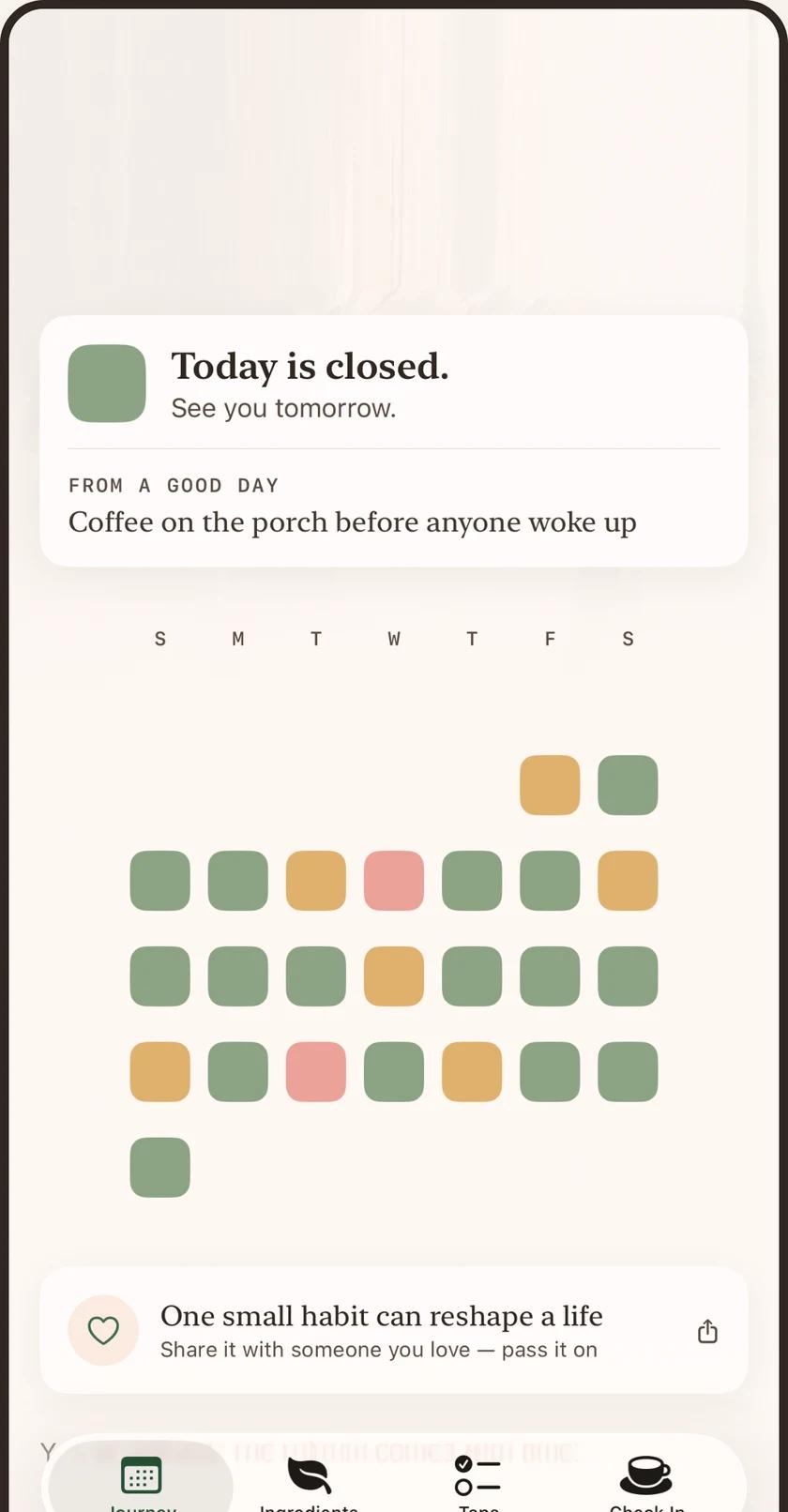
It is easy to track steps and forget people. HealthBrew's nightly close takes about a minute and, after a few weeks, shows your pattern, including the days you connected with someone. Membership, cancel anytime.
Educational content, not medical advice. Sources, read as PubMed abstracts on 10 November 2026 (we did not read the full papers): Holt-Lunstad et al., PLoS Medicine, 2010; Wang F et al., Nature Human Behaviour, 2023; Wang X et al., Nature Communications, 2026; Prigerson et al., Scientific Reports, 2025; Kahlon et al., JAMA Psychiatry, 2021; Lim et al., Social Psychiatry and Psychiatric Epidemiology, 2025.
Common questions
Does loneliness shorten your life?
It is linked to it. A 2023 analysis of 90 cohort studies and 2,205,199 people (Wang et al., Nature Human Behaviour) found that social isolation went with a 32% higher risk of death from any cause and loneliness with a 14% higher risk. These are observational studies, and poor health can also cause isolation, so they show a link, not proof of cause.
What is the difference between loneliness and social isolation?
Social isolation is having few social contacts. Loneliness is the feeling of being alone, whatever the number of contacts. A person can have one without the other. In the 2023 analysis, isolation had the stronger link with death from any cause.
What has been shown to reduce loneliness?
Two things have been tested in randomized trials. In 240 homebound adults in Texas (Kahlon et al., JAMA Psychiatry, 2021), four weeks of regular phone calls from trained young callers improved loneliness by 1.1 points on a 3 to 9 scale. In 4,284 adults across three countries (Lim et al., 2025), one act of kindness a week for four weeks reduced loneliness by a small amount in the USA and the UK, but not in Australia.
HealthBrew app
What do your own best days have in common?
HealthBrew is a habit tracker built by a physician. Close your day in about 60 seconds. After a few weeks, your AI companion shows you what your best days share.



Educational, not medical advice.
Building this into your own days? Habit Tracker App: How to Pick One You Will Keep
Related guides
Healthy-living advice, by email.