Quitting Smoking at Any Age: What 1.48 Million People Show
It is not too late at 40, 50 or 60. The gains start showing in under three years.
People who have smoked for decades often ask whether stopping now still does anything. The largest recent study says yes, at every age it looked at, and sooner than most people expect.
What smoking costs
Researchers pooled four national cohorts from the United States, the United Kingdom, Norway and Canada: 1.48 million adults aged 20 to 79, followed for 15 years, with 122,697 deaths (Cho 2024, NEJM Evidence).
People who smoked had close to three times the risk of dying of people who never smoked (2.8 times for women, 2.7 for men), after adjusting for age, education, alcohol use and obesity. Between the ages of 40 and 79, they lost 12 years of survival (women) and 13 years (men).
What quitting gets back
Former smokers sat much closer to people who had never smoked: 1.3 times the risk, in both women and men.
The study then asked how fast that happens. Among people who had quit less than three years earlier, the extra risk of death that comes with smoking was lower by:
- 95% in women and 90% in men under 40
- 81% in women and 61% in men aged 40 to 49
- 63% in women and 54% in men aged 50 to 59
Across all ages, compared with people who kept smoking, quitting for less than three years went with about 5 years of life not lost. Quitting for ten years or more went with about 10, which put survival close to that of people who never smoked.
The authors' summary is that quitting at every age was associated with longer survival, and most of all before 40.
The heart takes longer
A second study looked at heart and blood vessel disease in 8,770 people from the Framingham Heart Study, followed for a median of 26.4 years (Duncan 2019, JAMA). Its main analysis was of 2,371 heavy smokers, meaning 20 pack-years or more. A pack-year is a pack a day for a year.
Compared with those who kept smoking, people who had quit within the past five years had a 39% lower risk of heart attack, stroke, heart failure or cardiovascular death.
Compared with people who had never smoked, the picture was slower. Risk stayed measurably higher for years, and stopped being clearly higher only somewhere between 10 and 15 years after quitting.
So two things are true together. The drop starts fast. Getting all the way back takes a long time, which is a reason to start the clock now.
What to do tonight, with a number
Pick a quit date within the next 14 days and write it down. The 14 days is ours. Neither study tested how to quit; they measured what happened to people who did.
Save one number in your phone: 1-800-QUIT-NOW (1-800-784-8669). It is the US quitline, and the call costs nothing. A coach can help you make a plan. Smokefree.gov, run by the National Cancer Institute, has text programs too.
Tell one person the date. Then ask your doctor or pharmacist what could help you. That is their call to make with you, not ours.
The honest part
These are observational studies. Nobody was assigned to quit or to keep smoking, and people who manage to quit differ from people who do not in ways a study cannot fully measure. Smoking status was self-reported. The percentages describe groups, not what will happen to one person.
The second study's main numbers are about heavy smokers and about the heart and blood vessels, not every cause of death.
And we read the abstracts of these papers, not the full texts.
Where HealthBrew fits
HealthBrew is not a quit-smoking program. It is where you mark each day, and a run of smoke-free days is easier to protect when you can see it. HealthBrew's nightly close takes about a minute and, after a few weeks, shows your pattern. Membership, cancel anytime.
Educational content, not medical advice. Sources, read as PubMed abstracts on 10 November 2026 (we did not read the full papers): Cho et al., NEJM Evidence, 2024; Duncan et al., JAMA, 2019. Quitline number from smokefree.gov, read the same day.
Common questions
Is it too late to quit smoking at 50 or 60?
No. In a study of 1.48 million adults in four countries (Cho et al., NEJM Evidence, 2024), quitting at every age was associated with longer survival. Among people aged 50 to 59 who had quit less than three years earlier, the extra risk of death linked to smoking was 63% lower in women and 54% lower in men. The study is observational.
How quickly does risk fall after you quit smoking?
In the same study, gains showed within three years. Across all ages, quitting for less than three years went with about 5 years of life not lost compared with continued smoking, and quitting for ten years or more with about 10 years, which put survival close to that of people who never smoked.
How long until heart risk returns to that of someone who never smoked?
In heavy smokers from the Framingham Heart Study (Duncan et al., JAMA, 2019; 8,770 participants, 2,371 heavy smokers), quitting within five years went with a 39% lower risk of cardiovascular disease than continuing to smoke. Compared with people who never smoked, risk stopped being clearly higher only between 10 and 15 years after quitting.
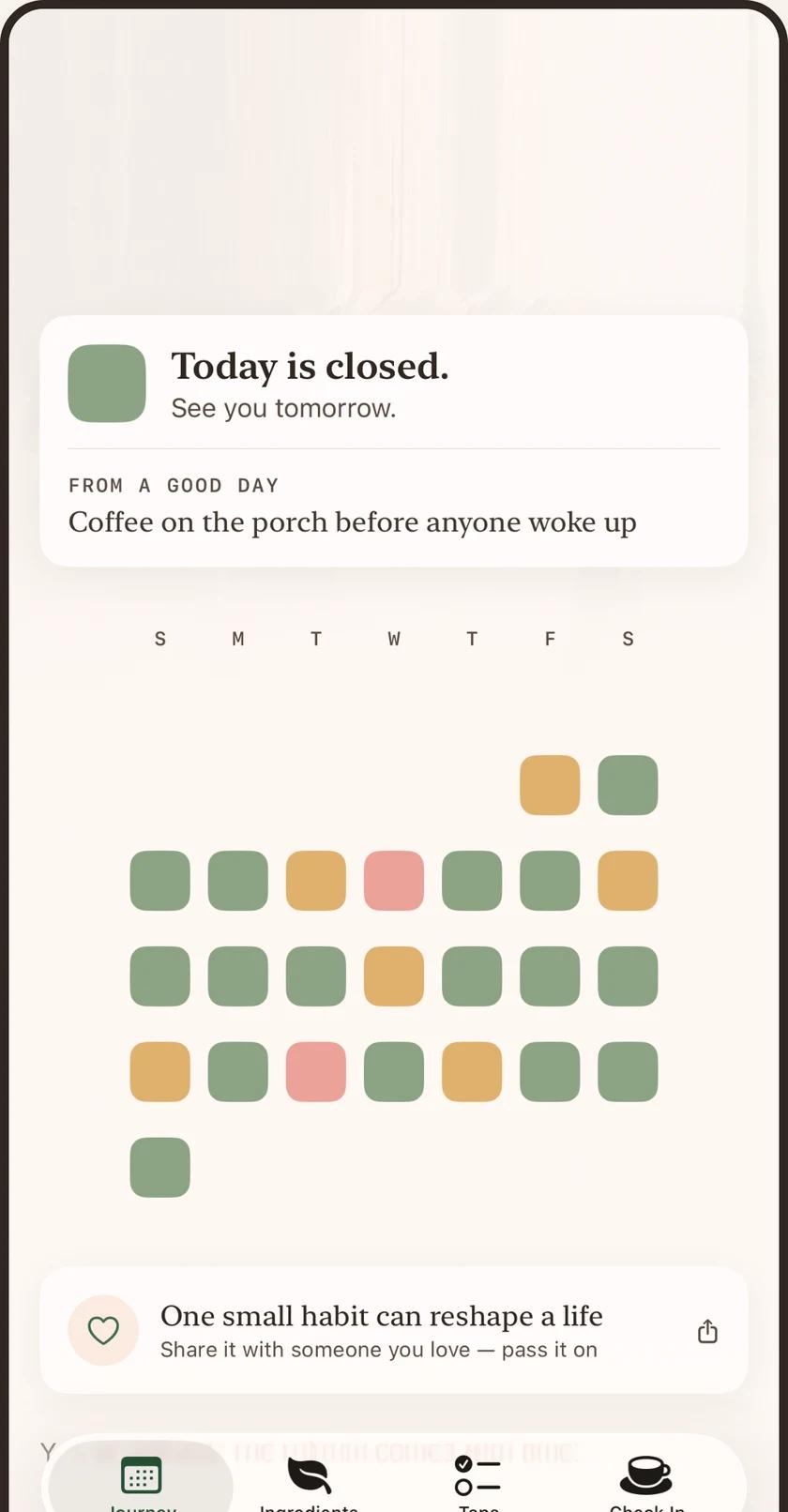
HealthBrew app
What do your own best days have in common?
HealthBrew is a habit tracker built by a physician. Close your day in about 60 seconds. After a few weeks, your AI companion shows you what your best days share.



Educational, not medical advice.
Building this into your own days? Quit Vaping App: Track the Habits That Help You Quit
Related guides
Healthy-living advice, by email.