Beethoven's 60 Coffee Beans (2026): Who Actually Counted Them, and Why It Matters
It is the most charming detail in classical music. It rests on the testimony of a documented forger, and nobody who repeats it says so.
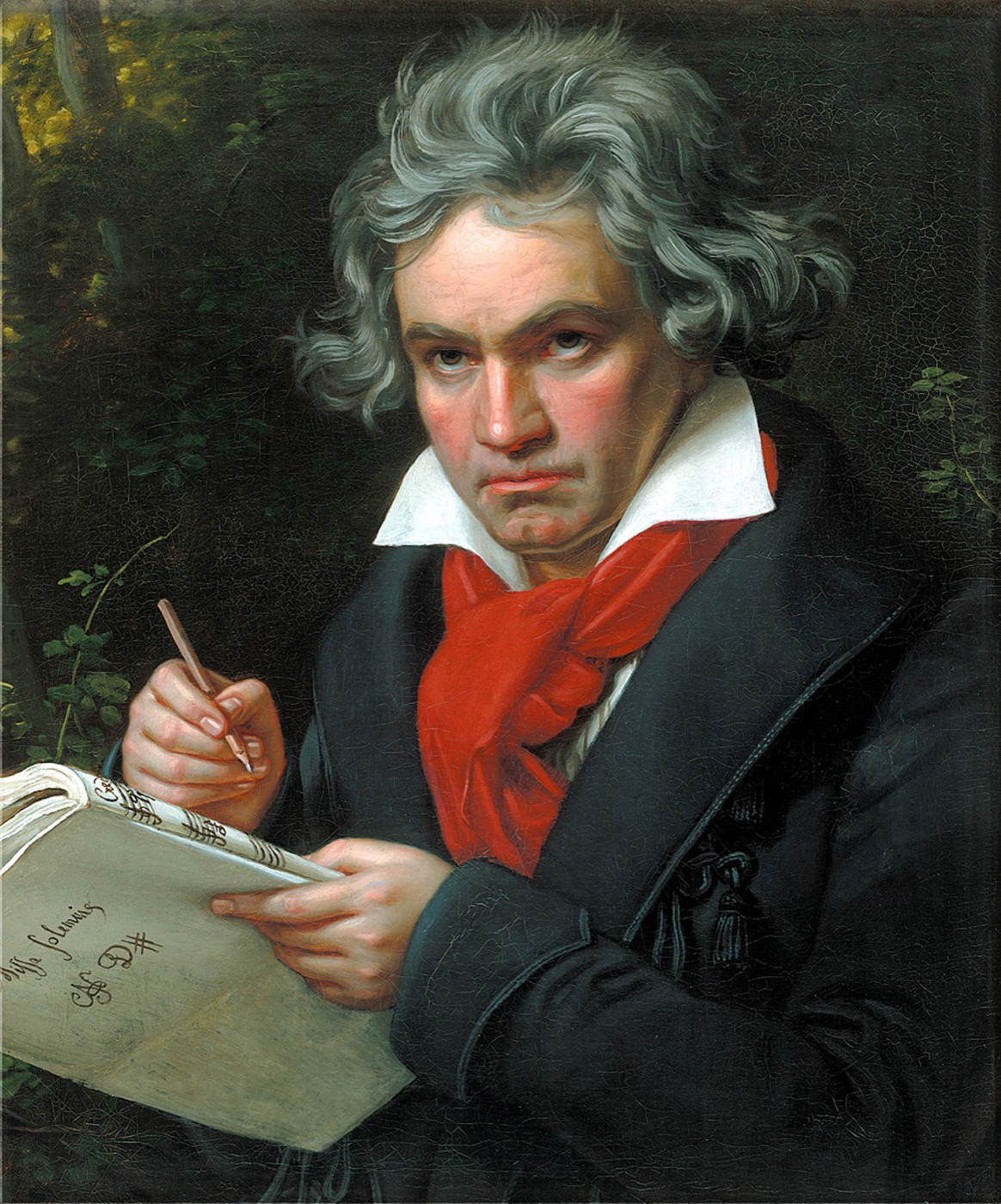
Beethoven wrote the Ninth Symphony while too deaf to hear it performed. That is documented biography, and it is the fact everything else about him gets hung on.
The internet has attached a smaller one to it. Every morning, the story goes, he made his coffee by counting out exactly sixty beans per cup, recounting if he lost track, and being especially careful when guests were watching. It is a lovely detail. It makes a giant feel like a person with a kitchen.
We went looking for who saw him do it. The answer is one man, and he is the least reliable witness in Beethoven scholarship.
Where the 60 beans actually comes from
The sentence traces to Anton Schindler, Beethoven's sometime unpaid secretary, in his 1840 biography. Here is the passage in full, from the 1841 English edition edited by Ignaz Moscheles, which is free to read on Project Gutenberg:
"For his breakfast he usually took coffee, which he frequently prepared himself; for in this beverage he had an oriental fastidiousness of taste. He allowed sixty beans for each cup, and lest his measure should mislead him to the amount of a bean or two, he made it a rule to count over the sixty for each cup, especially when he had visitors. He performed this task with as much care as others of greater importance."
Read that carefully, because two things in it get lost in retelling.
First, this is Schindler's narration, not Beethoven's words. There are no quotation marks around anything Beethoven said about coffee. He is not on record about beans at all. Every "Beethoven said" version of this story on the internet has put words in a dead man's mouth that the source never claims he spoke.
Second, the counting is per cup, and especially in front of visitors, not a private dawn ceremony. Schindler describes a man being fussy at guests, which is a different and frankly funnier story than the one usually told.
The problem with the only witness
Schindler is not a neutral narrator. He is the reason a corrective biography of Beethoven had to be written at all.
Beginning with Peter Stadlen's article "Schindler's Beethoven Forgeries" in The Musical Times in July 1977, musicologists established that Schindler had written entries into Beethoven's conversation books, the notebooks visitors used to talk to a deaf man, after Beethoven died in 1827, filling blank pages to inflate his own closeness to the composer. When the Berlin editors reached volume 7 of the German edition in 1978, they printed a supplement listing roughly 120 falsified entries across the earlier volumes. Schindler also destroyed a large share of the books outright, and claimed over a decade of intimacy where scholars put the real association at five or six years.
So the man who tells us about the beans forged the primary evidence about himself, in the very documents where a coffee habit would have shown up.
Alexander Wheelock Thayer wrote his biography precisely because Schindler's account was riddled with discrepancies, working directly on the conversation books Schindler had sold to the royal library in Berlin. The coffee sentence survives in the later Thayer tradition largely by being repeated from Schindler, not by being independently confirmed from those notebooks.
What we searched, and what we found
Asserting that something is uncorroborated is a claim, so here is the work behind it.
We read the full 1841 Moscheles edition of Schindler's biography and searched every occurrence of "coffee" in it. The sixty-beans sentence appears once, in the passage above. The same book's other coffee mentions are about coffee houses, Beethoven reading newspapers at a favorite café once or twice a week and slipping out the back door.
We then went to an independent eyewitness. Gerhard von Breuning was a boy who visited Beethoven constantly in the composer's final years and published his memoir, Aus dem Schwarzspanierhause, in 1874. It is counted among the classic firsthand sources. We searched the full German text on the Internet Archive: three mentions of coffee, zero of "Bohnen" (beans), and not one word about counting. One of the three is Beethoven saying to Schindler, on a sour morning, "Sie werden doch vorher noch Kaffee nehmen?!", roughly, "You'll have coffee first, surely?!" A man who drank coffee. Not a man documented counting it.
What we did not do: read the German first edition of 1840 directly, or the Barista Hustle two-part research piece on Beethoven's coffee, which is behind a paywall we did not pay. We are not citing what we could not read.
So the honest verdict is not "the 60 beans is fake." It is: one source says it, that source is a proven forger, and no independent witness backs him up. Treat it as a good story rather than a documented routine.
What the science says about the part that is real
Strip out the counting and something real remains: a consistent, measured, morning-only dose of caffeine. That part has evidence behind it, and it is about timing, not ritual.
Caffeine six hours before bed still cost people over an hour of sleep, and they could not tell. Drake, Roehrs, Shambroom and Roth, in the Journal of Clinical Sleep Medicine (2013), gave 12 healthy sleepers 400mg of caffeine at bedtime, 3 hours before bed, and 6 hours before bed, in a randomized double-blind placebo-controlled crossover, each person did every condition, serving as their own control. All three timings significantly disrupted sleep versus placebo. At six hours before bed, objectively measured total sleep time fell by more than an hour. Their subjective reports did not register the loss. Twelve people is a small study; the design is strong and the direction is consistent.
Caffeine's half-life means the morning dose is mostly gone by evening. The US Food and Drug Administration puts the half-life, the time for half the dose to clear, at four to six hours in a typical adult. A morning cup is down to a quarter or less of its starting level by dinner. That is the actual reason a breakfast-only coffee habit is a sane one.
How fast you clear it is not the same for everyone. Grzegorzewski and colleagues, in Frontiers in Pharmacology (2022), pooled caffeine pharmacokinetic data from 141 publications covering 4,714 individuals and found consistent, reproducible effects across more than fifty years of research: smoking speeds caffeine clearance and shortens its half-life, while oral contraceptive use does the opposite. Age, body weight, pregnancy and liver function move it too. The cutoff that works for your friend is not automatically yours.
Sleep is the floor this all sits on. Watson et al. the American Academy of Sleep Medicine and Sleep Research Society consensus (2015), puts the adult target at at least 7 hours. Caffeine late in the day is a direct tax on that number, and Drake's study shows you will not feel the bill.
Why a counted dose is the interesting part
Sixty beans is roughly an espresso-sized dose. A single arabica bean runs somewhere around a tenth of a gram, so sixty lands near the 15-to-20 grams a modern double shot uses, an estimate from bean-weight arithmetic, not a sourced measurement, because the bean-weight figures we could find were trade blogs rather than primary data.
The point is not the number. It is that Schindler's Beethoven had one dose, at one time of day, and it did not drift. Most people's caffeine problem is not the first cup, it is the fourth one at 4pm that they do not count, do not remember, and then blame on stress at midnight. A fixed morning dose is a decision made once. An uncounted afternoon habit is a decision remade badly, every day.
How to run it yourself, starting tonight
- Set your caffeine cutoff at bedtime minus 8 hours, and put it in your phone as a daily alarm tonight. If you sleep at 11pm, the cutoff is 3pm. Drake's 6-hour finding is the minimum the authors support; two hours of margin covers the slower-clearing half of the population.
- Count your doses for one week: actual cups, written down. Not to cut them. Most people genuinely do not know their own number until they see seven days of it.
- Keep your total under 400mg a day, the amount the FDA describes as not generally associated with harm for most healthy adults. Roughly two to three cups of brewed coffee, depending badly on the cup.
- Move the cup, don't cancel it. If the afternoon coffee is the problem, shift it to your first two waking hours rather than quitting outright. You are changing the clock, not the habit.
- Protect 7 hours in bed as the fixed thing and let caffeine timing bend around it, not the other way around.
The mistakes that kill this habit
- Trusting how you feel instead of the clock. This is the whole lesson of Drake's study: the 6-hour group lost over an hour of sleep and reported nothing wrong. Your sense of "coffee doesn't affect me" is exactly the signal that failed in the lab.
- Copying the ritual and skipping the timing. Counting beans is theater. Morning-only is the mechanism.
- Treating one witness as history. This applies past coffee. When a routine detail is too neat, ask who saw it, Schindler is a reminder that a charming story and a verified one are different objects.
- Fixing the cutoff and wrecking the night anyway. Caffeine timing does nothing if you are in bed for six hours. The 7-hour floor comes first.
- Adding an afternoon cup to survive a short night. That is the loop closing on itself: short sleep, more caffeine, later caffeine, shorter sleep.
Where HealthBrew fits
HealthBrew is built on closing the day honestly, writing down what you actually did, not what you meant to do. A caffeine cutoff is a good thing to close on, because it is binary and it takes two seconds: hit it, or didn't. After a couple of weeks you stop guessing whether coffee is costing you sleep and start seeing it next to your own nights. Membership, cancel anytime.
Educational and behavioral only, not medical advice, and nothing here is for preventing, diagnosing, or treating anything. Beethoven died in 1827; nothing on this page suggests any habit of his affected his health, his hearing, or his death. And the survivorship line: we write about people who became famous. Plenty of people count their coffee, sleep well, and compose nothing. The habit is not what made him Beethoven.
Common questions
Did Beethoven really count 60 coffee beans every morning?
One source says so: Anton Schindler, in his 1840 biography, "He allowed sixty beans for each cup, and lest his measure should mislead him to the amount of a bean or two, he made it a rule to count over the sixty for each cup, especially when he had visitors." That is Schindler narrating, not Beethoven quoted; Beethoven is not on record about it. And Schindler is the witness musicology trusts least: Peter Stadlen showed in The Musical Times (July 1977) that he forged entries into Beethoven’s conversation books after the composer died, and the 1978 Berlin edition listed around 120 falsified entries. We also searched Gerhard von Breuning’s 1874 eyewitness memoir in full: three mentions of coffee, none of counting, and no mention of beans. Best treated as a good story, not a documented routine.
How late is too late for coffee?
Drake, Roehrs, Shambroom and Roth (Journal of Clinical Sleep Medicine, 2013) gave 12 healthy sleepers 400mg of caffeine at bedtime, 3 hours before bed and 6 hours before bed in a randomized double-blind placebo-controlled crossover. All three disrupted sleep versus placebo, and at six hours before bed measured total sleep time dropped by more than an hour, while participants reported noticing nothing. The authors support a minimum 6-hour gap. Because the FDA puts caffeine’s half-life at four to six hours and clearance varies a lot between people, an 8-hour cutoff gives you margin. It is a small study, but each person served as their own control.
Is a single measured morning coffee actually better than several cups?
The evidence is about timing and total amount, not about counting. The FDA describes up to 400mg a day as not generally associated with harm for most healthy adults, and Drake et al. (2013) shows that late doses cost measured sleep even when you cannot feel it. So the useful part of the Beethoven story, if Schindler is even reporting it accurately, is that the dose was fixed and confined to breakfast. Clearance also differs person to person: Grzegorzewski et al. (Frontiers in Pharmacology, 2022), pooling 141 publications and 4,714 individuals, found smoking shortens caffeine’s half-life and oral contraceptives lengthen it. Adults still need 7+ hours of sleep (Watson et al. SLEEP, 2015).
Start Compounding Your Habits Tonight.
Use the free reflection generator to log your day. Let your AI companion coach help you find your baseline and have more days you would want again.
Produce OutcomesRelated guides
- The Tom Brady Sleep Schedule (2026): The 8:30 Bedtime, What He Actually Said, and the Part With No Evidence →
- The Barack Obama Daily Routine (2026): "The Fourth Quarter", the Two Suits, and the Sleep Number Nobody Can Source →
- The Andrew Huberman Morning Routine (2026): The Sunlight Habit, and How Solid the Evidence Actually Is →
Want more days like theirs — measured on your own life?
HealthBrew is a physician-built longevity habit tracker. Close your day in about 60 seconds; your AI companion coach finds what your best (“green”) days have in common. Educational self-reflection — not medical advice.
Close tonight · ~60 seconds