The Barack Obama Daily Routine (2026): "The Fourth Quarter", the Two Suits, and the Sleep Number Nobody Can Source
He cut his wardrobe down to two suit colors so he would have decision-making left for the part of the day he actually cared about: the hours after everyone else went to bed.
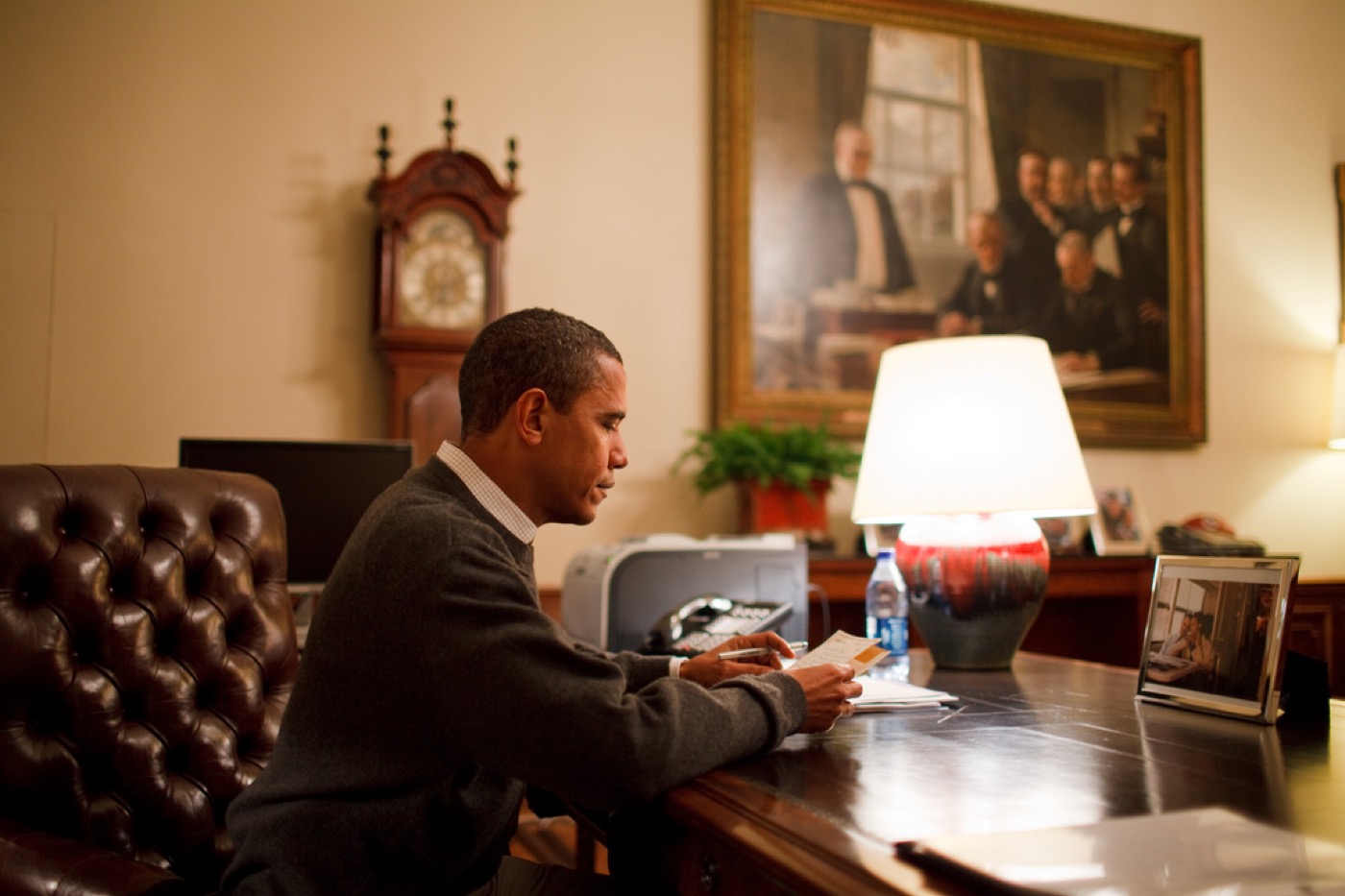
Most people who work late are losing a fight. The day ran long, the work spilled over, and the night is where the overflow goes.
Barack Obama's late nights were the opposite. They were the part of the schedule everything else was arranged around, and he rearranged his meals and his closet to protect them.
Almost every night in the White House he ate dinner with Michelle and the girls at 6:30, then walked down the hall to the Treaty Room, his private office on the second floor of the residence. Close aides told the New York Times in July 2016 that he spent four or five hours up there, largely alone. Staff knew the pattern from the other end: emails after 1 a.m. off a secure BlackBerry. He calls himself a "night guy."
The suits are part of the system
The most-quoted thing Obama ever said about his working method came from Michael Lewis's profile "Obama's Way," in the October 2012 Vanity Fair, reported with months of access to the president.
On his wardrobe: "You'll see I wear only gray or blue suits. I'm trying to pare down decisions. I don't want to make decisions about what I'm eating or wearing. Because I have too many other decisions to make."
Then the reasoning, the half almost everyone drops: "You need to focus your decision-making energy. You need to routinize yourself. You can't be going through the day distracted by trivia."
Read those next to the Treaty Room and it stops looking like two habits and starts looking like one. His explanation is simple: decide fewer small things during the day, and you have more left for the big ones at night. That is his reasoning, not a proven mechanism, the lab research on "decision fatigue" has had a hard time replicating. But you don't need the theory to copy the move. Most of us protect our calendar. He was protecting what he had left to think with, then spending it at the hour most people write off.
What he did with the hours
He read ten letters from the public every night, chosen by staff. Not a summary. The letters.
He ate almost nothing, or so the story goes. His former chef Sam Kass told the Times: "Michelle and I would always joke: Not six. Not eight. Always seven almonds." The word joke is sitting right there. Three weeks later Obama went on TODAY and said the teasing had been reported as if he were counting them out, "the weird way that the press works." The almonds are real; the ration is not.
And he wrote. On drafting his memoir A Promised Land, Obama said: "I'm a night writer. So usually my best writing was done after Michelle and the girls had gone to bed. I'd probably stay up until two o'clock in the morning." The reason is the thesis in one line: "From about 10 to 2 is when I could really lock in and I didn't have a lot of distractions."
He wrote longhand, on yellow legal pads. That was 2020, out of office, the same block, the same hours.
The sleep number nobody can source
Search "Barack Obama sleep" and you get five hours, everywhere, stated flatly. We went looking for who said it. We could not find him saying it, or a named aide saying it.
We did find a plausible origin. Obama has twice described his nights on the record, and both times he gave a bedtime, not a total:
- To Newsweek's Jon Meacham in 2009: he worked "until about 11:30 p.m." then read for half an hour before bed, "about midnight, 12:30 a.m. sometimes a little later."
- On ABC's Live With Kelly and Michael in 2014: he worked "until like 2 o'clock at night, reading briefings and doing work," and woke around 7.
Take the second and subtract. You get five. That is almost certainly the source: arithmetic on one described night, published as a standing schedule. But 2 a.m. to 7 is his late night, and the 2009 answer puts him in bed by half past midnight, closer to six and a half.
The honest verdict:
- The 6:30 dinner and the four-to-five-hour Treaty Room block, verified. New York Times, July 2016, from close aides.
- "From about 10 to 2 is when I could really lock in", verified. Obama on writing A Promised Land.
- The two suit colors and the reason: verified. Obama to Michael Lewis, Vanity Fair, October 2012.
- "Obama sleeps five hours a night", not traceable. He never said it, and no named aide said it.
That changes what you copy. "Sleep five hours" is an instruction derived from a number he never gave. "Guard a block of quiet hours and stop spending judgment on trivia" is what he did.
What the science says
Writing your own behavior down is one of the better-evidenced habit tools there is. A meta-analysis of 122 studies found interventions prompting people to self-monitor clearly outperformed those that did not (Michie et al. Health Psychology, 2009). His block produced written output, not more input.
A visible sense of progress separates good working days from bad ones. Amabile and Kramer coded roughly 12,000 diary entries from 238 people and found progress on meaningful work beat every other candidate (Amabile & Kramer, 2011). Diary coding, not an experiment: a pattern, not a proven cause.
Habits take longer to set than the internet says. In the study behind the "66 days" figure, 96 volunteers self-reported a daily behavior for twelve weeks; the median time to automaticity was about 66 days, range 18 to 254, calculated on the 39 whose curves the model fitted, not all 96 (Lally et al. 2010). Small sample, self-reported.
And the caution, plainly: adults need seven hours or more. The American Academy of Sleep Medicine and the Sleep Research Society ran a consensus panel and concluded adults should regularly sleep 7 or more hours, with less linked to worse outcomes (Watson et al. SLEEP, 2015). This is where the routine stops being a model. Whatever his real total was, a 2 a.m. finish and a 7 a.m. start does not clear that floor. The short night is not the lesson, it is the cost, and he paid it with a physician down the hall and a helicopter instead of a commute.
What none of this proves. Obama worked late and Obama became president. Two facts side by side, not a chain. He is an unusually good writer with an unusual tolerance for solitude, and he had a staff whose job was removing every other decision from his day. Nobody is bringing you ten hand-picked letters. Plenty of people work from 10 to 2 and it costs them their mornings and their health.
Why the block beats the willpower
The interesting move is not the late hour. It is that he stopped asking himself for discipline at the moment of the work. Most people chase focused hours by resolving to concentrate harder, a request for willpower at exactly the time of day willpower is thinnest.
His version front-loads all of it into arrangements. The suits were decided once, years ago. Dinner is at a fixed time with the same people. Walking down the hall into that room means one thing. By 10 p.m. there is nothing left to decide, which is what makes the hour usable, and why the block outlasted the job. When he sat down to write A Promised Land, the staff and the BlackBerry were gone, and 10 to 2 was still there.
How to run it yourself, starting tonight
- Pick the two-hour window your house actually goes quiet, and name it. For him it was after 10. Yours might be 5:30 a.m. The hour is not the point; the absence of interruption is.
- Cut one recurring decision this week, permanently. Not five. One. The same breakfast every weekday, or work clothes that all go together. Stop spending judgment on trivia.
- Make the block produce something written. Output, not input: reading the news is not the same activity. Self-monitoring beat the alternatives across 122 studies (Michie et al. 2009).
- Give it a physical trigger. He walked down a hall into a particular room. Use a different chair or a lamp you only switch on for this, so the move itself is the start signal.
- Protect the wake time, not the bedtime. Here you part company with him. Fix the hour you get up, count back seven, and let that set the end of your block, ninety minutes if that is what is left.
- Expect it to take a season. The median time to automaticity was about 66 days, range up to 254, over the 39 of 96 enrolled whose curves the model fitted (Lally et al. 2010). Judge this in March, not on Thursday.
The mistakes that kill this habit
Copying the sleep instead of the block. He never gave the five-hour figure, and it sits under the seven-hour floor the AASM panel landed on (Watson et al. 2015). Borrow the protected hours, not a number the internet invented.
Turning the block into an inbox. Four hours of email is not four hours of work. His produced letters answered and pages written. If yours only produces replies, you have moved your workday later rather than added to it.
Skipping the decisions half. The suits are the funding mechanism, not a footnote. Guard your 10 p.m. hours while still agonising over lunch and you arrive already spent.
Starting at four hours, or letting it eat the family dinner. He had a residence, a chef, and no commute, and the 6:30 dinner still came first. A four-hour nightly block on top of an ordinary job is how you quit in eight days. Ninety minutes that survives a bad week beats four hours that survives none.
Treating exhaustion as proof it is working. Running on short sleep and feeling wrecked is information, not commitment. Persistent exhaustion, heavy snoring, or all-day sleepiness is a conversation with a doctor.
Where HealthBrew fits
What generalises is unglamorous: he did the same thing at the same hour for years, and the effect only shows up on that timescale.
HealthBrew's nightly close is a sixty-second version of that record. How the day went, what you did, when you finished. After a few weeks it shows what you cannot see from inside a single day, which evenings come before your good mornings, and whether your block is happening or only intended. Membership, cancel anytime.
One last thing. We wrote about Obama because his habits were documented, which is a biased way to pick anyone. Thousands of people guard two quiet hours and nobody profiles them. They just get their work done on a normal Wednesday.
Educational content, not medical advice. This page is about a documented work habit and takes no position on anything else. Sources: Michael Lewis, "Obama's Way," Vanity Fair, October 2012; Michael D. Shear, New York Times, July 2016; Obama on writing A Promised Land, 2020; his 2009 remarks to Jon Meacham and 2014 remarks on ABC's Live With Kelly and Michael. The "five hours of sleep" figure is not traceable to Obama or a named aide, and we do not repeat it as fact. Short sleep is a cost, not a technique, persistent exhaustion deserves a doctor.
Common questions
What was Barack Obama's daily routine as president?
The best-documented part is the evening. The New York Times reported in July 2016 that he ate dinner with his family at 6:30 almost every night, then withdrew to the Treaty Room, his private office on the second floor of the residence, where close aides said he spent four or five hours largely alone. He read ten letters from the public chosen daily by staff, snacked on almonds, and emailed staff past 1 a.m. The famous "seven almonds" detail came from his former family chef Sam Kass describing a running joke; Obama said on TODAY in July 2016 that it had been reported as if he were counting them out. He calls himself a "night guy."
Why did Obama only wear gray or blue suits?
To save his decision-making for bigger things. He told Michael Lewis for the October 2012 Vanity Fair profile "Obama's Way": "You'll see I wear only gray or blue suits. I'm trying to pare down decisions. I don't want to make decisions about what I'm eating or wearing. Because I have too many other decisions to make." He went on: "You need to focus your decision-making energy. You need to routinize yourself. You can't be going through the day distracted by trivia."
Did Barack Obama really only sleep five hours a night?
There is no primary source for it, not from him, not from a named aide. The likely origin is arithmetic on one self-described night: on ABC's Live With Kelly and Michael in 2014 he mentioned working "until like 2 o'clock at night" and waking around 7. Subtract and you get five. But in 2009 he told Newsweek's Jon Meacham that he read until about 11:30 p.m. and went to bed "about midnight, 12:30 a.m. sometimes a little later," which is closer to six and a half. Either way it sits below the 7 or more hours the American Academy of Sleep Medicine and Sleep Research Society consensus panel recommends for adults (Watson et al. SLEEP, 2015). The protected block is the copyable part, not the short night.
Start Compounding Your Habits Tonight.
Use the free reflection generator to log your day. Let your AI companion coach help you find your baseline and have more days you would want again.
Produce OutcomesRelated guides
Want more days like theirs — measured on your own life?
HealthBrew is a physician-built longevity habit tracker. Close your day in about 60 seconds; your AI companion coach finds what your best (“green”) days have in common. Educational self-reflection — not medical advice.
Close tonight · ~60 seconds