Purpose in Life and Longevity: What 488,765 People Show
A reason to get up is on the longevity list. So is helping someone for about two hours a week.
Most longevity advice is about the body. A growing pile of research is about something else: whether you feel your days are for something.
Purpose
A 2026 analysis pooled 25 samples from the United States, Europe and Asia: 488,765 people, 48,928 deaths, and up to 32 years of follow-up (Sutin 2026, Psychological Medicine).
People with a stronger sense of purpose had a 24% lower risk of dying during follow-up (hazard ratio 0.76). The authors describe it as roughly 30%, using the inverse of the same number.
Then they tested how much of that was really something else. After accounting for behavior and clinical risk factors, the figure fell to 15%. After accounting for depression, it fell to 9%. It shrank each time. It did not go away.
Optimism
Two long-running US cohorts, women from the Nurses' Health Study followed for 10 years and male veterans followed for 30, were scored on optimism by questionnaire (Lee 2019, PNAS). The abstract we read does not give the number of people.
Women in the most optimistic quarter lived 14.9% longer than women in the least optimistic quarter, after adjusting for demographics and health conditions. Results in men were similar. The most optimistic had 1.5 times (women) and 1.7 times (men) the odds of reaching age 85.
A larger and more diverse study checked this in 159,255 women (Koga 2022, Journal of the American Geriatrics Society). There the gap was smaller: 5.4% longer life in the most optimistic quarter. It was 7.6% in Black women and 5.1% in non-Hispanic White women. In Hispanic/Latina and Asian women the estimates were too uncertain to call.
One detail matters. Healthy habits explained only 24% of the link. So optimists are not simply people who exercise more.
Helping
Researchers tracked 12,998 US adults over 50 through changes in how much they volunteered (Kim 2020, American Journal of Preventive Medicine). Four years on, people who volunteered 100 hours a year or more, compared with none, had a lower risk of dying and of physical limitations. They were more active, and they reported more purpose and optimism and less loneliness.
The same study is honest about what did not move. Volunteering was not linked to diabetes, high blood pressure, stroke, cancer, heart disease, or chronic pain.
A second study followed 17,972 US adults for more than two decades (Han and Faul 2026, Alzheimer's & Dementia). Among people who carry APOE e4, a gene variant linked to faster cognitive decline, taking up formal volunteering and keeping at it went with a slower decline. The link showed at four hours a week or less. The abstract gives no effect size, so we cannot say how much slower.
What to do tonight, with a number
Write one sentence that finishes "Tomorrow is for..." Keep it under 20 words. A person, a piece of work, a thing you are building. This is our exercise, not one from the studies. The studies measured purpose. They did not test a way to raise it.
Find 2 hours this week to help someone. One hundred hours a year, the amount in the volunteering study, works out to about two hours a week. That arithmetic is ours. A shift at a food bank counts. So does driving a neighbor to an appointment.
The honest part
Illness takes purpose and optimism away. So part of this link runs backward: people who were already getting sick scored lower and also died sooner. The researchers adjusted for health, and the purpose study shows how much the number shrinks when they do.
Nobody in these studies was assigned to feel more purposeful. The optimism authors say optimism can be changed and call it a target worth testing. That is a proposal, not a result.
And none of this means a serious illness is a failure of attitude. Pessimists are not doing it wrong. If you feel hopeless most days, please talk to a doctor or a counselor. In the US you can call or text 988 at any hour.
Where HealthBrew fits
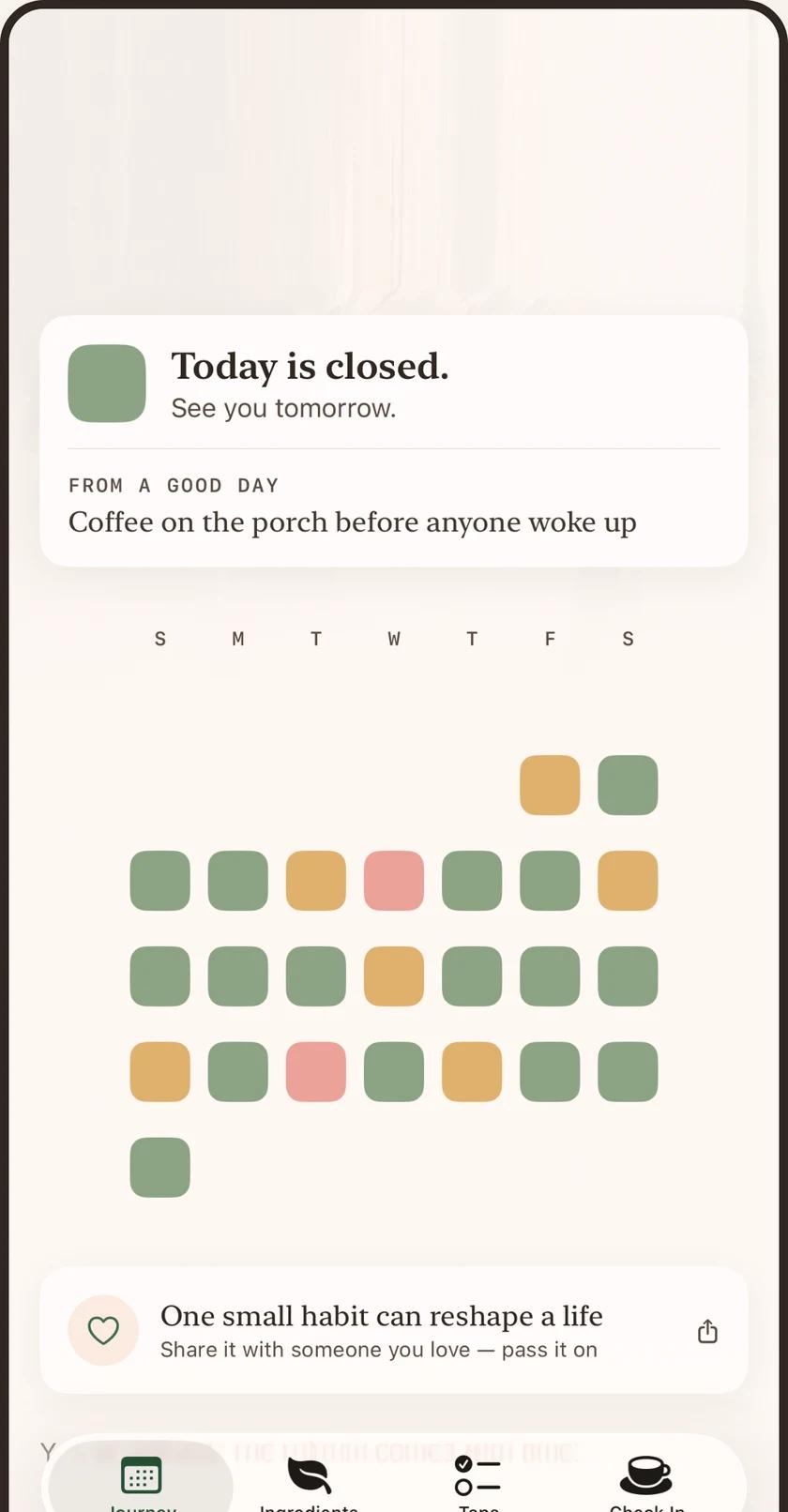
Purpose shows up in ordinary days, and ordinary days are easy to forget. HealthBrew's nightly close takes about a minute and, after a few weeks, shows your pattern. Membership, cancel anytime.
Educational content, not medical advice. Sources, read as PubMed abstracts on 10 November 2026 (we did not read the full papers): Sutin et al., Psychological Medicine, 2026; Lee et al., PNAS, 2019; Koga et al., Journal of the American Geriatrics Society, 2022; Kim et al., American Journal of Preventive Medicine, 2020; Han and Faul, Alzheimer's & Dementia, 2026.
Common questions
Does having a purpose in life help you live longer?
It is linked to it. A 2026 analysis of 25 samples and 488,765 people (Sutin et al., Psychological Medicine) found that a stronger sense of purpose went with a 24% lower risk of death (hazard ratio 0.76). The figure fell to 15% after accounting for behavior and clinical risk factors and to 9% after accounting for depression. The studies are observational and no trial has tested whether raising purpose adds years.
Do optimists live longer?
In two US cohorts (Lee et al., PNAS, 2019), women in the most optimistic quarter lived 14.9% longer than women in the least optimistic quarter, and results in men were similar. In a larger study of 159,255 women (Koga et al., 2022) the gap was 5.4%. Healthy habits explained only 24% of the link in that study. These are associations, not proof of cause.
How much volunteering is linked to better health?
In 12,998 US adults over 50 (Kim et al., American Journal of Preventive Medicine, 2020), volunteering 100 hours a year or more, about two hours a week, went with a lower risk of death and of physical limitations four years later, compared with none. It was not linked to diabetes, high blood pressure, stroke, cancer or heart disease.
HealthBrew app
What do your own best days have in common?
HealthBrew is a habit tracker built by a physician. Close your day in about 60 seconds. After a few weeks, your AI companion shows you what your best days share.



Educational, not medical advice.
Building this into your own days? Habit Tracker App: How to Pick One You Will Keep
Related guides
Healthy-living advice, by email.