What Is Flourishing? The Five Parts of a Good Life, Measured
Living longer is one goal. Researchers have a name, and a five-part measure, for living well.
Healthspan asks how many years you live in good health. Flourishing asks a wider question: is your life going well, across the board? Researchers have tried to pin that down so it can be measured.
The five parts
A 2017 paper argued that most studies look at one narrow outcome, such as income, a single disease, or mood (VanderWeele 2017, PNAS). It proposed that flourishing covers five things:
- happiness and life satisfaction
- mental and physical health
- meaning and purpose
- character and virtue
- close social relationships
The paper reviewed long-term and experimental studies to find what shapes each one, and proposed ways to measure them. Health is on the list. It is one of five.
A later version of the measure adds a sixth part, financial and material stability.
Money is not the whole score
One study gave the questionnaire to 8,873 people in five countries: the United States, Mexico, Sri Lanka, Cambodia and China (Weziak-Bialowolska 2019, Frontiers in Psychology).
The US respondents had the highest financial and material stability. They also scored lowest of the five groups on every other part except happiness and life satisfaction. The respondents in Mexico had the lowest financial scores and the highest sense of meaning and purpose.
Read that with care. These were not national samples. The US respondents were customers of one financial company, and the others were clothing factory workers in one brand's supply chain. It tells you the parts can come apart. It does not rank countries.
A much larger project is now under way. The Global Flourishing Study is following more than 200,000 people in 22 countries, with nationally representative samples and yearly surveys planned for five years (VanderWeele 2025, Nature Mental Health). The abstract we read describes the study and does not give headline numbers, so we will not quote any.
What predicts aging well
The longest evidence comes from a study that followed two groups of boys, 237 college students and 332 core-city youths, for 60 years or until death (Vaillant 2001, American Journal of Psychiatry).
How well the men were aging at 70 to 80 could be predicted from things measured before 50. Seven of those were at least partly under their control: alcohol abuse, smoking, a stable marriage, exercise, body weight, how they coped with trouble, and education.
Here is the hopeful part. Once those seven were accounted for, only one factor outside their control still predicted how they aged: depression. Parents' social class, family closeness in childhood and how long their ancestors lived did not.
Everyone in the study was male.
A five-question check
If you want a tested tool, the WHO-5 Well-Being Index is five questions, first published in 1998 and translated into more than 30 languages. A review of 213 articles found it valid as a measure of well-being and as a screening tool for depression (Topp 2015, Psychotherapy and Psychosomatics). The abstract does not list the questions, so we do not reproduce them here.
What to do tonight, with a number
Rate each of the five parts from 0 to 10. Happiness, health, meaning, character, close relationships. Five numbers, two minutes. This quick rating is ours. It is not the published questionnaire and it has not been tested.
Circle the lowest number and pick one thing to do about it in the next 7 days. Low on relationships: call one person tonight. Low on meaning: write one sentence about what tomorrow is for. Low on health: set a fixed wake time and get at least 7 hours of sleep (Watson 2015).
Do it again in 30 days. The point is to see which part moved.
The honest part
Flourishing is a framework, not a finding. The five parts are a reasoned proposal about what a good life includes, and other researchers draw the lines differently. The cross-country study used convenience samples. The 60-year study was of men only, and it shows what predicted aging well, not what caused it.
A low score is information, not a verdict. Some of these parts depend on money, health and luck more than on effort. If you feel low or hopeless most days, please talk to a doctor or a counselor. In the US you can call or text 988 at any hour.
Where HealthBrew fits
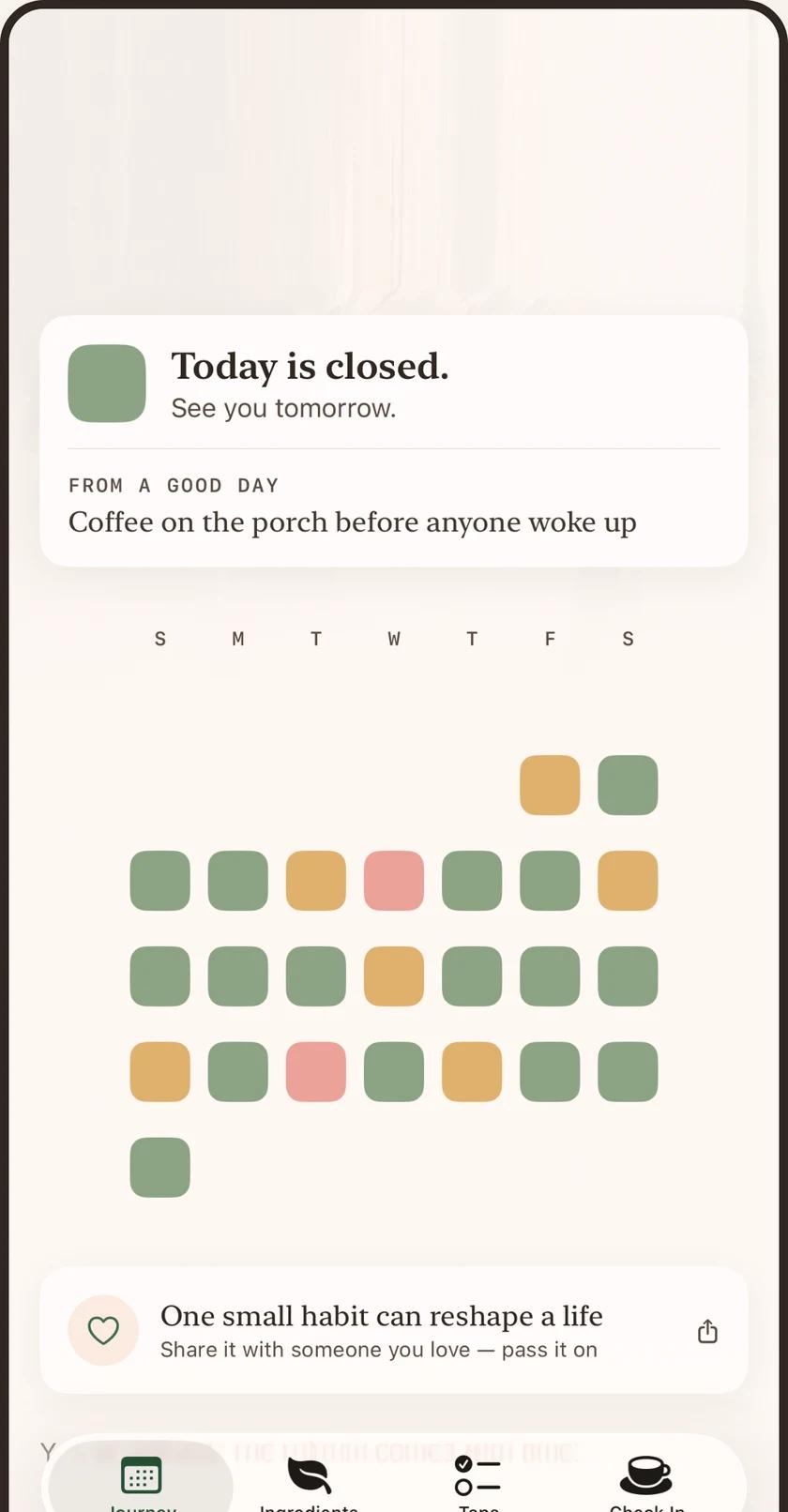
One self-rating is a snapshot. A good life is built on ordinary days. HealthBrew's nightly close takes about a minute and, after a few weeks, shows your pattern. Membership, cancel anytime.
Educational content, not medical advice. Sources, read as PubMed abstracts on 10 November 2026 (we did not read the full papers): VanderWeele, PNAS, 2017; Weziak-Bialowolska et al., Frontiers in Psychology, 2019; VanderWeele et al., Nature Mental Health, 2025; Topp et al., Psychotherapy and Psychosomatics, 2015; Vaillant and Mukamal, American Journal of Psychiatry, 2001; Watson et al., consensus statement of the American Academy of Sleep Medicine and Sleep Research Society, 2015.
Common questions
What does flourishing mean?
In research, flourishing means doing well across several parts of life at once. A widely used definition (VanderWeele, PNAS, 2017) names five: happiness and life satisfaction, mental and physical health, meaning and purpose, character and virtue, and close social relationships. A later version adds financial and material stability.
How is flourishing different from healthspan?
Healthspan counts the years lived in good health. Flourishing is wider: health is one of its five parts, next to happiness, meaning, character and close relationships. A person can be in good health and still score low on the other parts.
What predicts aging well?
In a study that followed 237 college men and 332 core-city men for 60 years (Vaillant and Mukamal, American Journal of Psychiatry, 2001), aging well at 70 to 80 was predicted by seven factors measured before 50 that were at least partly under personal control: alcohol abuse, smoking, a stable marriage, exercise, body weight, coping style and education. All participants were men, and the study shows prediction, not cause.
HealthBrew app
What do your own best days have in common?
HealthBrew is a habit tracker built by a physician. Close your day in about 60 seconds. After a few weeks, your AI companion shows you what your best days share.



Educational, not medical advice.
Building this into your own days? Habit Tracker App: How to Pick One You Will Keep
Related guides
Healthy-living advice, by email.