Arts, Nature and Dancing: The Longevity Habits Nobody Lists
A concert, a street with trees, a dance class. All three show up in long-term studies of who lives longer.
Longevity lists are full of things to give up. Some of the research is about things people enjoy: a concert, a walk under trees, a dance floor, a weekly gathering. Here is what the studies found, and how far to trust them.
Museums, concerts and theater
English researchers followed 6,710 adults aged 50 and older for 14 years (Fancourt 2019, BMJ). They asked how often people went to museums, galleries, exhibitions, the theater, concerts or the opera.
Compared with people who never went:
- going once or twice a year went with a 14% lower risk of dying
- going every few months or more went with a 31% lower risk
That held after accounting for money, health, habits and social life. The authors say it plainly in their own abstract: the study was observational, so cause cannot be assumed.
Trees near home
A US study followed 108,630 women and used satellite images to measure how green the area around each home was (James 2016, Environmental Health Perspectives). There were 8,604 deaths between 2000 and 2008.
Women in the greenest fifth, measured within 250 meters of home, had a 12% lower rate of death than women in the least green fifth. The link was strongest for deaths from respiratory disease and cancer.
The researchers also looked at why. Part of the link ran through more physical activity, cleaner air, more social contact and less depression.
Note what was measured. This is where people lived, not how often they went for a walk in a park.
Dancing
A pooled analysis of 11 British surveys followed 48,390 adults aged 40 and older, with 1,714 deaths from heart and blood vessel disease (Merom 2016, American Journal of Preventive Medicine).
Moderate-intensity dancing went with a 46% lower risk of cardiovascular death. Moderate-intensity walking went with a 33% lower risk. The dancing estimate is less precise: its confidence interval is wide, from 0.34 to 0.87. Light-intensity dancing and walking showed no link.
So the effort matters. You should be breathing harder.
Why might dancing do well? An experiment tested two parts of it separately: effort, and moving in time with other people (Tarr 2015, Biology Letters). Each one on its own raised pain tolerance and made people feel closer to the group. The abstract we read does not give the number of participants.
Weekly gatherings
The largest studies of regular gatherings are about religious services, so that is what we can report.
Among 74,534 US women, those who attended a service more than once a week had a 33% lower risk of death than those who never attended (Li 2016, JAMA Internal Medicine). The researchers measured what explained it. Social support accounted for 23%, less smoking for 22%, fewer depressive symptoms for 11%, and optimism for 9%.
A later analysis of three US cohorts found a 26% lower risk of death with weekly attendance (Chen 2021, International Journal of Epidemiology). It also found something that did not move: attendance was generally not linked to later disease, such as high blood pressure, stroke or heart disease.
The authors of that study are careful, and we will be too. They write that people do not choose a faith for health reasons, and that their findings apply to people who already hold beliefs. This is not advice to join anything. What the numbers do suggest is that showing up somewhere, every week, with the same people, is worth something.
What to do tonight, with a number
Put one arts outing on your calendar in the next 30 days. A museum, a concert, a play. The 30 days is ours. In the study, even once or twice a year showed a link.
Dance to three songs tonight. About ten minutes, hard enough that you are breathing faster. The three songs are ours. The study counted moderate-intensity dancing only.
Pick one weekly thing with the same people and go this week. A class, a choir, a service if you have one, a standing coffee.
And keep the basics: at least 7 hours of sleep (Watson 2015).
The honest part
Every large study here is observational. People who go to concerts, live on green streets, dance and attend weekly gatherings tend to be healthier, better off and more mobile to begin with. Someone who is ill stops going out. Researchers adjust for this and cannot remove it.
Where you live is often not a choice. A study about green neighborhoods says more about city planning than about personal effort.
And we read the abstracts of these papers, not the full texts.
Where HealthBrew fits
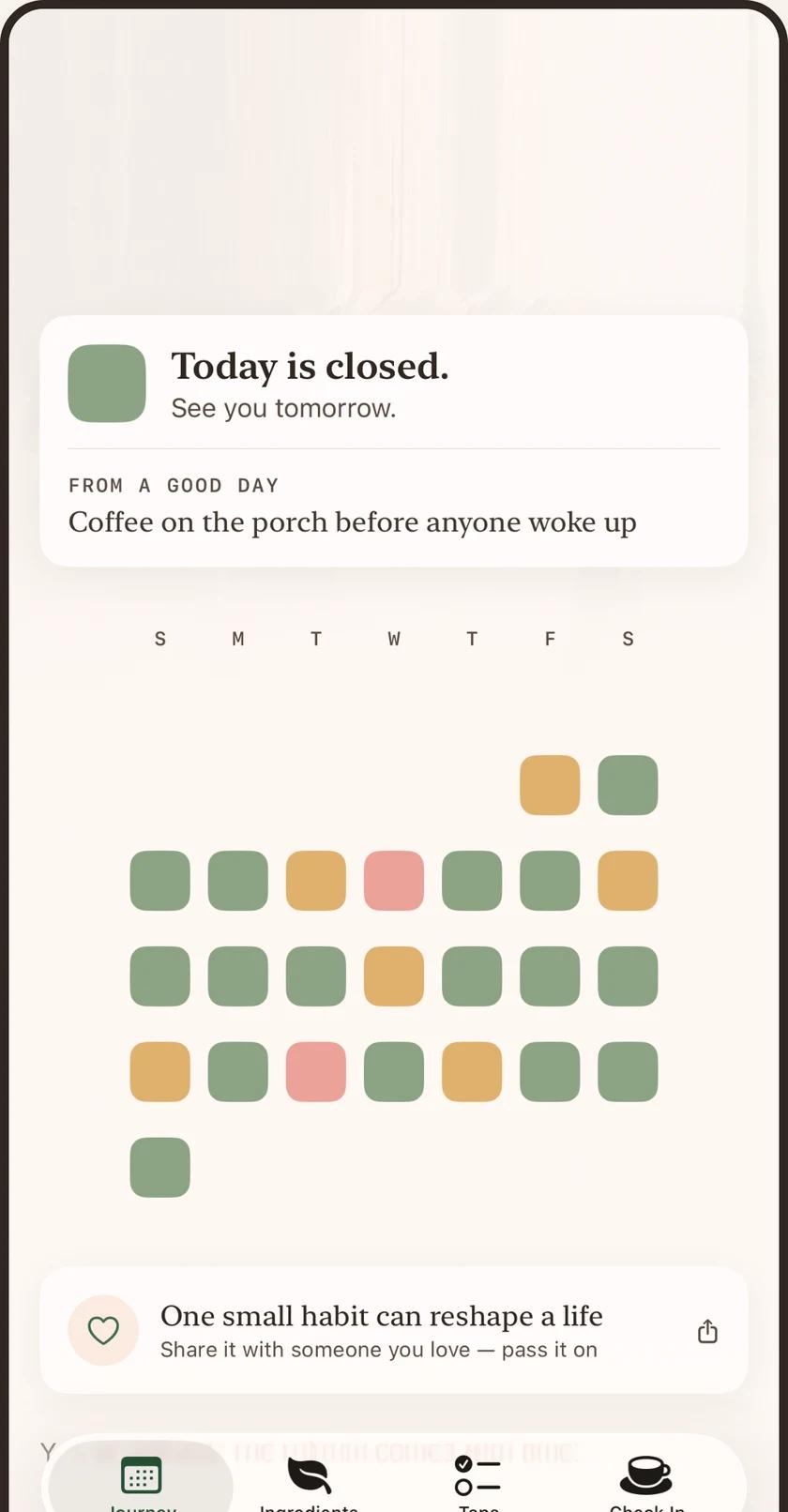
These are the habits that fall off first in a busy week, because nobody counts them. HealthBrew's nightly close takes about a minute and, after a few weeks, shows your pattern. Membership, cancel anytime.
Educational content, not medical advice. Sources, read as PubMed abstracts on 10 November 2026 (we did not read the full papers): Fancourt and Steptoe, BMJ, 2019; James et al., Environmental Health Perspectives, 2016; Merom et al., American Journal of Preventive Medicine, 2016; Tarr et al., Biology Letters, 2015; Li et al., JAMA Internal Medicine, 2016; Chen et al., International Journal of Epidemiology, 2021; Watson et al., consensus statement of the American Academy of Sleep Medicine and Sleep Research Society, 2015.
Common questions
Does going to museums and concerts help you live longer?
It is linked to it. In 6,710 English adults aged 50 and older followed for 14 years (Fancourt and Steptoe, BMJ, 2019), going to museums, galleries, theater or concerts every few months or more went with a 31% lower risk of dying, and once or twice a year with a 14% lower risk, compared with never going. The study was observational, so cause cannot be assumed.
Is dancing as good as walking for your heart?
In a pooled analysis of 48,390 British adults aged 40 and older (Merom et al., American Journal of Preventive Medicine, 2016), moderate-intensity dancing went with a 46% lower risk of cardiovascular death and moderate-intensity walking with a 33% lower risk. Light-intensity dancing and walking showed no link. Activity was self-reported and the study is observational.
Does living near green space affect how long you live?
In 108,630 US women (James et al., Environmental Health Perspectives, 2016), those living in the greenest fifth of areas, measured within 250 meters of home, had a 12% lower rate of death than those in the least green fifth. Part of the link ran through physical activity, air quality, social contact and depression. The study measured where people lived, not time spent outdoors.
HealthBrew app
What do your own best days have in common?
HealthBrew is a habit tracker built by a physician. Close your day in about 60 seconds. After a few weeks, your AI companion shows you what your best days share.



Educational, not medical advice.
Building this into your own days? Habit Tracker App: How to Pick One You Will Keep
Related guides
Healthy-living advice, by email.